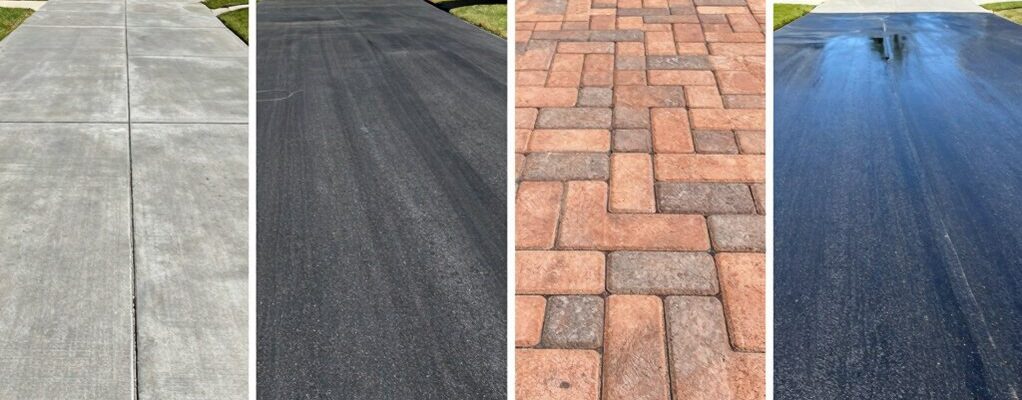
You can get a durable driveway without paying for premium, only if you match the material to your budget and climate. Concrete, asphalt, pavers, and resin each balance cost, longevity, and upkeep in different ways. You’ll want to weigh upfront vs. long-term expenses, install timelines, and how each choice fits your home’s look. There’s more to contemplate beyond initial price, and your best option hinges on how you value resilience, maintenance, and curb appeal.
Concrete: Strengths, Costs, and Longevity
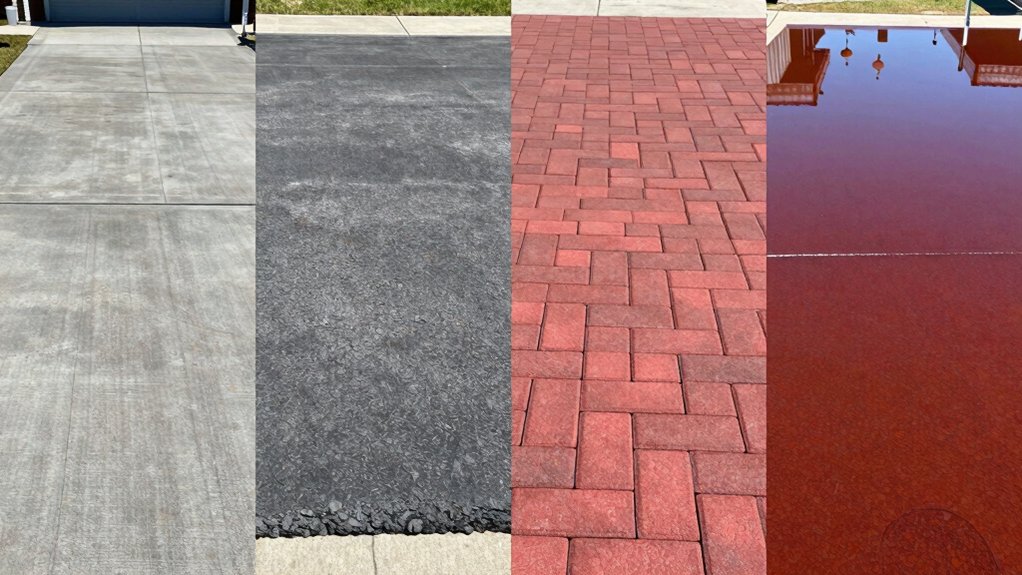
Concrete is a durable, cost-effective choice for driveways, offering strong load support and wide accessibility. You’ll appreciate precise strength metrics: compressive strength typically 3,000–5,000 psi, depending on mix and curing.
Durability hinges on proper dilution, reinforcement, and joint design; without them, cracking risks rise.
Initial costs are predictable, but long-term maintenance adds up when you factor sealing and potential repairs.
You should expect a lifespan around 25–40 years with proper care, though freeze–thaw cycles and deicing salts can shorten it.
Installation precision matters: formwork, air entrainment, and curing temperature influence surface integrity and longevity.
Maintenance is straightforward: periodic sealing every 3–5 years, timely crack filling, and prompt drainage correction.
Asphalt: Budget-Friendly Resilience and Maintenance
Asphalt offers strong upfront cost savings, but you’ll want to weigh long-term economics against maintenance and potential repair needs.
Expect periodic seal coats, crack patching, and timely emulsions to preserve longevity without ballooning costs.
Consider how aging factors like sun exposure and temperature cycles affect performance and total life-cycle value.
Cost-Effectiveness Over Time
Because asphalt typically offers lower upfront costs and straightforward maintenance, it often delivers strong short-term value. However, long-term cost hinges on climate, use, and routine care. Over time, you should quantify lifecycle expenses, including resurfacing intervals, crack sealing, and potential pothole repairs, to compare with alternatives.
You’ll find per-square-foot costs can shift with traffic patterns and seasonal temperature swings, influencing wear rates and maintenance frequency. Consider expected service life: asphalt generally requires more frequent resurfacing than concrete, yet each cycle tends to be cheaper, offering iterative cost efficiency if you stagger projects to avoid peak pricing.
Energy and emissions aren’t purely financial, but they affect total cost of ownership when fuel, equipment, and labor requirements differ across options. Alignment with climate, load, and scheduling remains the decisive factor.
Maintenance Tasks Ahead
Maintenance tasks ahead for asphalt focus on keeping budget-friendly resilience intact while preventing costly failures. You should prioritize routine inspection for cracks, pooling, and surface wear after seasonal shifts.
Address small cracks promptly with proper sealant and a compatible patch if separation occurs, preventing water intrusion that accelerates damage. Clean debris regularly to avoid pore blockage and weed growth that undermine edges.
Schedule periodic surface resealing based on climate and traffic, not calendar alone, to preserve binder integrity and color uniformity. Monitor edges where pavement meets foundations; stabilization prevents edge spalling under load.
Manage drainage to avoid standing water, which compounds freeze-thaw stress. Document maintenance, costs, and outcomes to optimize future interventions.
This disciplined approach sustains performance without triggering premature renewal expenses.
Longevity and Aging Factors
Longevity in asphalt hinges on aging mechanisms that degrade binder, aggregate, and joint seals over time. You’ll notice binder oxidation, fatigue cracking, rutting, and moisture intrusion eroding pavement performance.
As temperatures swing, binder becomes brittle or overly soft, accelerating cracks and pothole formation. Water presence, through poor drainage or freeze–thaw cycles, weakens the structure and enlarges cracks, inviting debonding at seams.
You should monitor surface oxidation, increased surface roughness, and color fading as early signs of aging, signaling maintenance windows. Regular seal coats slow binder loss, while timely crack sealing prevents moisture ingress and axle-load damage.
Proper Mix design, compaction, and drainage minimize aging onset. In budget-conscious scenarios, prioritize preventive maintenance to extend service life before costly rehab becomes unavoidable.
Pavers: Versatility, Aesthetics, and Repairability
Pavers offer notable versatility, aesthetics, and repairability, making them a strong option for driveways. You’ll appreciate modular design that accommodates irregular layouts and setbacks without sacrificing structural integrity.
Through a wide range of shapes, colors, and textures, you can tailor curb appeal while maintaining a cohesive, high-end look. Interlocking systems distribute loads efficiently, reducing deformation under heavy traffic and seasonal movement.
Aesthetic longevity is enhanced by the ability to replace individual pavers rather than entire areas, keeping maintenance predictable and costs controllable. Repair scenarios are straightforward: lift, replace, and reseat affected units with minimal disruption.
However, consider base preparation and drainage to prevent shifting. Longevity hinges on proper installation, joint stabilization, and pavement thickness relative to anticipated loads.
Resin Bound Surfaces: Modern Finish and Heat Resistance
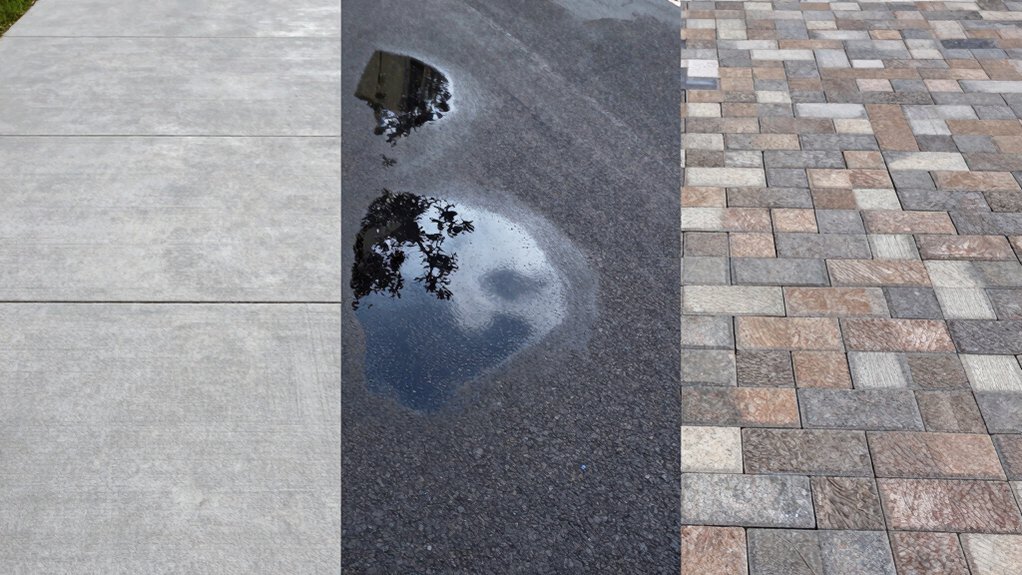
Resin bound surfaces offer a sleek, uniform finish that blends modern aesthetics with practical performance. You’ll notice a seamless appearance that resists color variation, keeping your driveway looking consistent over time.
The resin binder creates a dense, low-porosity surface, which helps hinder oil seepage and minimizes weed growth through joints. Heat resistance is a key consideration: while resins tolerate moderate temperatures, prolonged exposure to intense sun can soften binders in some formulations, potentially affecting surface rigidity.
Your choice should depend on the resin type, aggregate size, and curing system, since each combination yields different thermal behavior. You’ll benefit from good load distribution and a smoother ride, but need to confirm UV stability and maintenance needs with the supplier.
Installation Timelines and Processes for Each Material
You’ll compare timeline variations by material, then map the step-by-step installation for each option.
You’ll also assess curing requirements and access implications to keep crews on schedule and protect finished work.
This sets up a clear framework for how timelines, processes, and access impact choice and planning.
Timeline Variations by Material
Installation timelines vary by material, and understanding these differences helps you plan confidently: some options cure quickly and allow early traffic, while others require multi-day sequencing for base prep, set times, and joint stabilization.
You’ll note concrete typically progresses from compacted subbase to formwork, pour, and cure, with traffic restrictions easing after initial set but full strength requiring days.
Asphalt usually cures fast, enabling sooner use, yet temperature and compaction influence final surface quality and joint integrity.
Pavers demand a more deliberate sequence: base stabilization, bedding sand, and precise laying with edging, then compaction and joint filling, all while enabling staggered openings as sections complete.
Resin systems demand curing windows, moisture control, and cure time between layers, with minimal traffic during each stage.
Step-By-Step Installation
Step-by-step installation timelines and processes vary by material, so follow each system’s sequence precisely from subbase to final cure. You prepare the site by marking boundaries, removing debris, and ensuring drainage is directed away from the structure.
For concrete, you install compacted subgrade, lay a leveling bed, place forms, pour, strike, and joint, then cure under controlled conditions before opening traffic.
Asphalt requires fabric or base, asphaltic binder, and consistent compaction; you check for surface evenness and allow proper cooling before sealing.
Pavers demand a stable base, compacted sand bedding, careful alignment, and joint sand filling after placement.
Resin installations use a resinous primer, correct catalyst ratio, precise mixing, pour, distribute evenly, and vent to eliminate air pockets.
Throughout, verify tolerances, edge support, and drainage compatibility.
Curing and Access Considerations
Curing and access considerations must align with each material’s install timeline to prevent stalls and defects. You’ll follow material-specific cure windows and traffic allowances to minimize impact on usability.
Concrete requires controlled moisture and temperature, with curing periods typically shifting to avoid early loads. Access is limited during early strength gain to prevent cracking.
Asphalt lets you reopen faster, but temperature and compaction quality govern timing, so weekday pours may constrain driveway use until initial sealer cures.
Pavers demand minimal wearlike disruption, yet joint materials cure separately, affecting schedule flexibility.
Resin installations rely on ambient conditions and cure chemistry, so access is restricted during solvent evaporation and cure phases.
Plan adjacent work accordingly, coordinating crew, equipment, and inspections to keep timelines realistic and defects rare.
Maintenance Practices Across Materials
Effective maintenance varies by material, yet the core goal remains the same: keep surfaces clean, seal joints, and address wear before it spreads. You perform routine cleaning to remove debris, spills, and staining, since contaminants accelerate degradation.
For concrete and asphalt, you inspect cracks promptly and seal or fill to prevent moisture ingress; delayed repairs raise repair costs and shorten service life.
Pavers require joint regrading and sand stabilization to prevent weed growth and shifting; you reseal or clean grout lines as needed to maintain a uniform appearance.
Resin surfaces benefit from minimal moisture exposure and specialized cleaners that preserve translucency and slip resistance.
Schedule inspections seasonally, document findings, and prioritize timely, targeted interventions over broad, reactive treatments. Consistency yields predictable performance and longer-lasting driveways.
Climate Considerations and Performance by Material
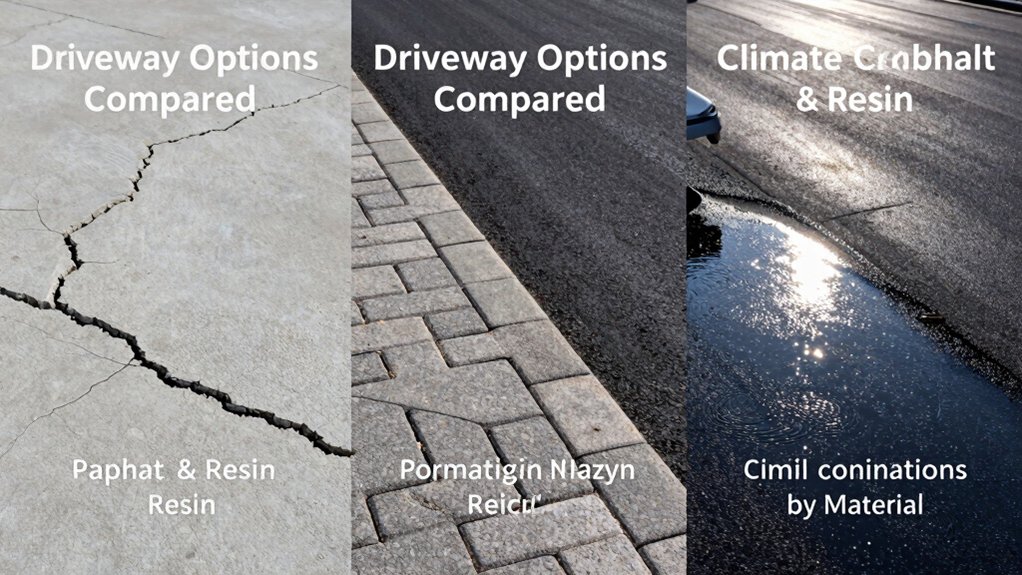
Climate impact varies by material, influencing heat absorption, freeze-thaw resilience, and overall longevity.
You’ll compare how each option handles temperature swings, moisture, and climate-specific stresses to forecast performance.
This sets up a precise, data-driven discussion on material suitability for your local conditions.
Climate Impact Variations
When climate factors vary, material choice for driveways affects performance in predictable ways: temperature swings, moisture exposure, and freeze–thaw cycles stress surfaces differently.
You’ll notice concrete resists mild temperature shifts but can crack under repeated heat and cold; expansion joints help, yet aging concrete may spall in freeze cycles.
Asphalt responds with ductility to heat, but prolonged high temperatures soften its surface and accelerate rutting; in cold, brittleness increases crack risk.
Pavers distribute load and tolerate movement, yet joint maintenance influences water infiltration and weed growth, altering long‑term stability.
Resin systems curb surface heat absorption, reducing thermal stress, though UV exposure and joint integrity determine durability.
Moisture control remains critical across materials, shaping underlayment needs, drainage design, and long‑term performance expectations.
Performance by Material
Material choice shapes how-driveways perform under varying climate conditions, and you can expect distinct strengths and vulnerabilities from each option. You assess performance by considering expansion, contraction, and heat response across seasons.
Concrete offers rigidity, low maintenance, and good load distribution, but can crack with freeze-thaw cycles and moisture ingress. Asphalt adapts to heat, seals quickly, and repairs are straightforward, yet it softens in high heat and ages with oxidation.
Pavers provide drainage and aesthetic variety; their joints accommodate movement, yet proper installation matters to prevent shifting. Resin systems resist cracking and provide seamless surfaces, though UV exposure and temperature swings can affect bond longevity.
Across materials, preparation, drainage, and proper sealing determine long-term resilience under climate stress. Regular inspection guarantees timely mitigation of material-specific vulnerabilities.
Lifecycles and Total Cost of Ownership
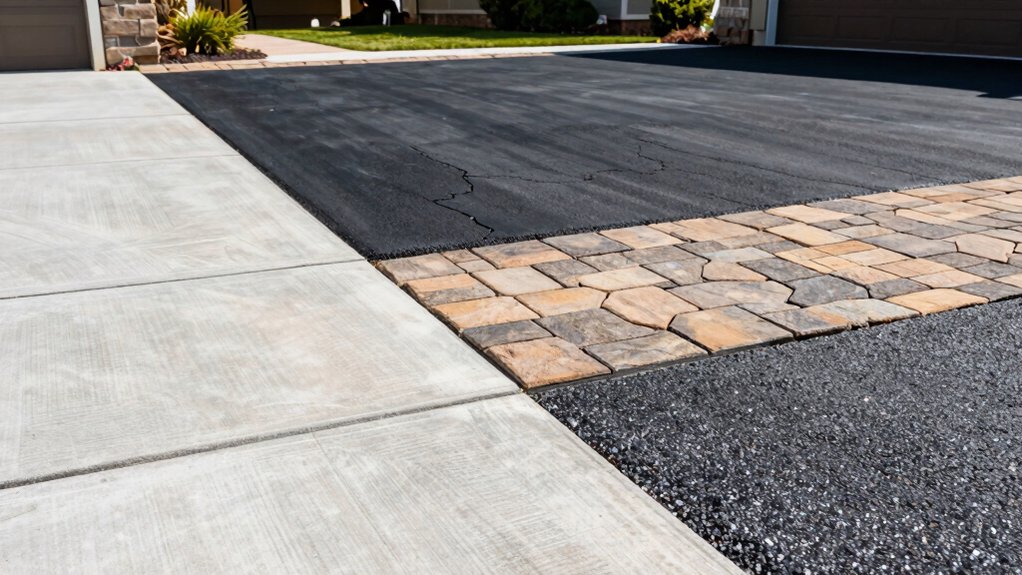
Lifecycles and Total Cost of Ownership (TCO) matter because initial price rarely tells the whole story: maintenance, energy use, repairs, and replacement cycles cumulatively shape long-term value. You’ll compare systems by schedule and cost paths, not just upfront quotes.
Concrete typically offers long service life with moderate maintenance but higher initial installation, influencing midlife expenses. Asphalt often starts cheap yet accumulates more frequent reseals and replacements, elevating cumulative costs.
Pavers distribute loads and allow targeted repairs, yet material and joint maintenance can raise annualized outlays. Resin tends to lower maintenance beneath certain climates but may incur specialized repairs and periodic resurfacing.
When evaluating TCO, factor downtime, disposal, and recycling credits. A transparent life-cycle model reveals whether a lower upfront price truly lowers total commitments across decades.
Design Options and Aesthetic Opportunities
Your design choices shape not just performance but the look and feel of the driveway across time. You’ll assess texture, color, and pattern options for each material, noting how these elements affect curb appeal, maintenance visibility, and aging.
Concrete offers clean lines and monolithic palettes, with the potential for stamp or color integral finishes that resist fading when properly sealed.
Asphalt emphasizes uniform, subtle tones and smoother profiles but may require color or chip blends to reduce heat absorption.
Pavers provide modular flexibility, varied patterns, and maintenance ease, yet joint durability matters in high-traffic zones.
Resin surfaces enable seamless color transitions and unique textures but demand UV stability and slip resistance assessments.
Align choices with climate, site exposure, and maintenance expectations for lasting aesthetic harmony.
Choosing the Right Driveway for Your Home and Budget
Choosing the right driveway for your home and budget starts with a clear assessment of priorities: climate, usage, maintenance tolerance, and upfront versus long-term costs.
You’ll compare material lifespans, installation complexity, and repair frequency to anticipate total ownership.
Climate dictates performance: freeze-thaw durability matters for concrete and asphalt, while resin and pavers tolerate heat differently.
Usage determines required load capacity and turning radius, influencing slab thickness or paver pattern.
Maintenance tolerance guides your decision on sealing, cleaning, and resealing intervals.
Upfront costs must be weighed against long-term expenses, including potential resurfacing or replacement timelines.
Consider aesthetics alongside functionality, but avoid over-investing in features that have limited value for your site.
Finally, align the choice with resale impact and neighborhood standards.
Pick a solution that meets budget without sacrificing performance.