
Condensation signals moisture, yet it doesn’t directly cause mold; it creates the damp conditions mold spores need to germinate. When warm, humid air meets cool surfaces, water droplets form and raise local moisture levels, especially on organic materials. You’ll want to track hotspots, ventilation, and insulation, because persistent dampness can support mold growth. If you ignore it, hidden risks accumulate and repair costs rise—so there’s value in understanding how to break the moisture cycle before it spreads.
What Is Condensation and How It Forms

Condensation occurs when water vapor in air loses enough energy to change into a liquid. You’re observing phase change driven by temperature and humidity differences.
When air cools to its dew point, molecules slow enough to form liquid droplets on surfaces or in the air. Relative humidity indicates how saturated the air is; at 100%, any further cooling or moisture addition prompts condensation.
The process is influenced by surface temperature, airflow, and nucleation sites, which provide initial gathering points for droplets.
In closed or semi-enclosed spaces, ongoing moisture sources—exhaled breath, cooking, showers—raise indoor humidity, increasing condensation risk on cool windows, walls, or pipes.
Condensation is reversible with heating, dehumidification, or improved ventilation, but persistence depends on ongoing moisture balance.
The Link Between Condensation and Mold Growth
Condensation provides the moisture that enables mold growth, especially on cool surfaces where water accumulates and remains available for colonization.
When relative humidity stays elevated and surfaces stay damp, mold spores germinate and propagate, forming detectable colonies more quickly in humid environments.
Understanding the moisture thresholds that trigger growth helps you target dehumidification and surface drying to mitigate health and structural risks.
Condensation and Mold Growth
When warm, moist air meets a cooler surface, condensation forms and can create the conditions that mold spores exploit to establish growth. You observe surface cooling, transient droplets, and high local humidity that sustain moisture availability on substrates.
In indoor settings, repeated condensation signals ongoing moisture imbalance, often driven by temperature gradients, insufficient ventilation, or elevated humidity from activities. Mold growth requires sustained moisture for spore germination, hyphal expansion, and nutrient access; condensation supplies both water and a conducive microenvironment.
Risk intensifies on organic materials, dust, or painted surfaces where moisture persists. Evidence links persistent surface moisture to higher mold incidence, faster colonization, and increased spore production.
Controlling condensation—via insulation, dehumidification, and balanced air exchange—reduces substrate moisture, limiting mold establishment without addressing spores directly.
Moisture-Driven Mold Formation
Moisture availability directly drives mold formation, as sustained surface moisture from condensation creates a microenvironment that supports spore germination, hyphal growth, and nutrient uptake.
You observe that moisture persistence determines fungal metabolic activation, with water activity above thresholds enabling enzymatic processes and substrate utilization.
In indoor settings, relative humidity and surface cooling create nanoscale moisture films beneath spores, facilitating adherence and colonization.
You’ll note that condensation events raise water potential at the substrate, accelerating hyphal extension and sporulation when nutrients are present.
Moisture-driven growth is often localized to porous materials, where capillary sorption sustains moisture longer than nonporous substrates.
Effective control reduces moisture supply, enhances ventilation, and targets thermal bridges to minimize sustained surface moisture, thereby suppressing mold establishment and propagation.
Common Hotspots in Homes and Buildings
You’ll want to inspect common moisture traps like kitchens, bathrooms, and laundry areas, where humid air can condense on cool surfaces.
Visible condensation hotspots often occur on windows, uninsulated walls, and piping leaks, signaling ongoing moisture exposure.
Addressing these zones with proper ventilation, insulation, and moisture control reduces mold risk and supports long-term indoor air quality.
Common Moisture Traps
Common moisture traps—places where warm, humid air meets cool surfaces—include bathrooms, kitchens, basements, laundry rooms, and crawl spaces. You should treat these areas as high-risk zones for dampness accumulation if ventilation is insufficient or air exchange is restricted.
In bathrooms, prolonged showers, defective exhaust fans, and inadequate sealing around fixtures drive sustained surface humidity.
Kitchens generate moisture through cooking, boiling, and dishwashing, especially without operable range hoods or properly vented ducts.
Basements and crawl spaces often lack humidity control and may experience elevated relative humidity, condensation on cold walls, and water intrusion.
Laundry rooms produce significant moisture from washers and dryers, particularly with improper venting or leaks.
Regular monitoring, dehumidification, and targeted ventilation reduce condensate formation and mold risk.
Visible Condensation Hotspots
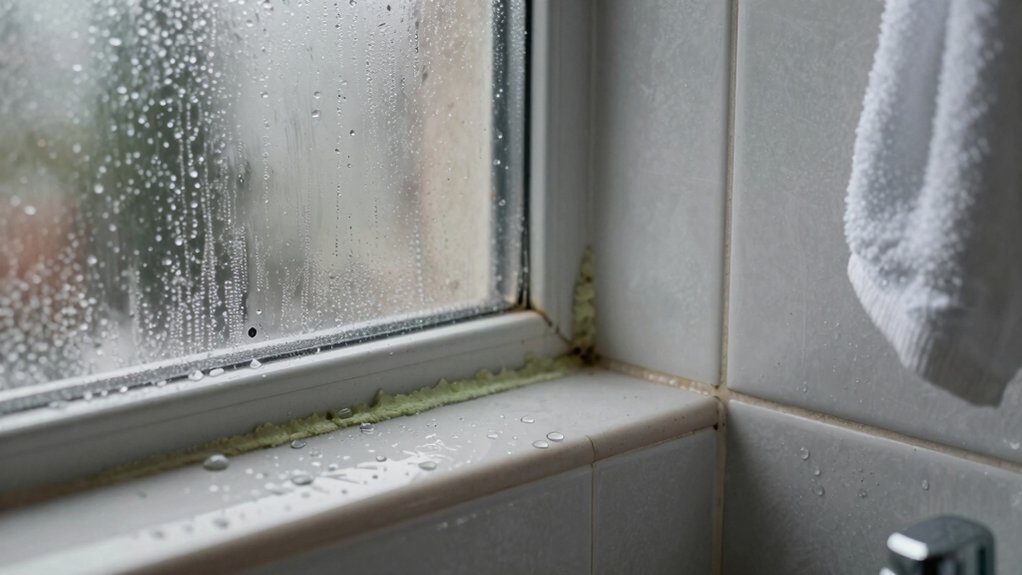
Visible condensation hotspots are where you’ll most often see droplets forming on cold surfaces, signaling ongoing heat and moisture exchange that can foster mold if unchecked. In buildings, these spots cluster around poorly insulated windows, exterior walls, and plumbing penetrations, especially where humidity is high and airflow is stagnant.
You’ll observe mist on glass during cold seasons or after hot showers, and glossy sheen on metal or concrete in basements. Data show surface temperatures approaching dew point trigger condensation; persistent moisture elevates indoor relative humidity, promoting microbial growth on organic substrates.
Avoid overcooling and ensure continuous drainage, proper ventilation, and targeted insulation at these hotspots. Regular inspection with moisture meters helps verify risk and guide remediation priorities.
Factors That Influence Mold Development Beyond Moisture
Even when moisture is controlled, several non-moisture factors reshape mold growth, including temperature, nutrient availability, surface materials, and airflow.
You assess how temperature thresholds influence spores’ germination and fungal physiology, noting that both high warmth and sudden cooling can alter growth rates.
Nutrient access, particularly organic substrates and dust-bound carbon sources, governs biomass accumulation and species selection.
Surface materials matter: cellulose-rich walls, mineral composites, and porous substrates create microenvironments with varying moisture retention and humidity pockets that favor certain taxa.
Airflow patterns determine dispersion, evaporation rates, and localized drying, affecting spore deposition and colony expansion.
You recognize that material adsorption properties, hygroscopic salts, and indoor chemistry interplay with moisture, shaping mold viability even when visible condensation is minimized.
Practical Ways to Reduce Humidity and Improve Ventilation
Reducing humidity and improving ventilation require targeted, evidence-based actions that lower moisture levels and promote air exchange.
In practice, monitor indoor RH with a calibrated hygrometer, aiming for 40–60% to deter mold growth. Use exhaust fans in bathrooms and kitchens to remove moist air at the source; ensure they vent outdoors and run long enough to replace air.
Dry laundry outside or use a vented dryer, and avoid indoor air drying. Increase air movement with strategically placed fans and reduce stagnant zones, particularly in corners and basements.
Seal leaks around windows, doors, and utility penetrations to minimize inward humid air; however, maintain gradual ventilation to avoid pressure imbalances.
Consider dehumidification devices in consistently damp spaces, selecting appropriately sized units for room volume. Regularly service HVAC systems to preserve efficiency.
When to Seek Professional Help and What to Do Next
If you notice persistent mold growth, recurring musty odors, or moisture problems that don’t respond to standard home measures, seek professional assessment promptly. A certified indoor air quality specialist or licensed contractor can identify moisture sources, assess condensation dynamics, and determine mold species with safe sampling when appropriate.
Expect a systematic process: visual inspection, moisture mapping, and HVAC and building envelope evaluation. They’ll distinguish between surface contamination and hidden infestation, guiding remediation plans anchored in evidence: containment, filtration, and material removal as needed.
Don’t delay if you have structural concerns, persistent water intrusion, or health symptoms. After assessment, follow documented remediation steps, verify containment and air clearance, and address prevention via airtight building envelopes, dehumidification, and continuous monitoring to minimize recurrence risk.
Maintain written records for future maintenance and insurance coordination.
Frequently Asked Questions
Can Mold Grow Without Visible Condensation Present?
Yes, mold can grow without visible condensation; microscopic moisture, high humidity, or damp materials suffice. You should monitor relative humidity, guarantee airflow, fix leaks, and dry hidden damp areas promptly to prevent unseen mold development.
Does Humidity Alone Cause Health Issues Besides Mold?
Humidity alone can cause health issues beyond mold, including irritation, wheeze, and headaches, especially for sensitive individuals. You may experience these symptoms even without visible mold, as high humidity impairs indoor air quality and promotes particulates. Monitor, mitigate, ventilate.
How Long Does Mold Remediation Typically Take at Home?
Remediation typically takes 1–5 days, depending on scope and containment. You’ll seal off areas, remove affected materials, clean surfaces with biocides, and retest humidity and air quality, ensuring containment, drying, and verification before declaring mold eradicated.
Are There Mold Species That Thrive in Dry Environments?
Yes, you’ll find certain species tolerate low humidity; they thrive in dry niches with minimal competition, irregular moisture, or dust-bound nutrients, but overall mold growth favors moisture, so reduce humidity, improve ventilation, and clean regularly to prevent them.
Do Air Purifiers Effectively Remove Mold Spores From the Air?
Yes, air purifiers reduce mold spores in the air, but they don’t eliminate mold growth; you must control moisture. Ironically, spotless air doesn’t help if your humidity stays high, so monitor RH and fix leaks alongside filtration.