
Manchester is one of the UK’s hottest markets, with rental yields averaging in the mid-to-high single digits and capital value growth outpacing many regions. Population growth, rising wages, and a vibrant tech, media, and student pipeline power demand, while regeneration and transport upgrades open up new corridors for value. You’ll see dense occupancy and limited supply keep momentum steady, but the real question is where—and when—to deploy capital to capture the upside before the next phase kicks in.
Why Manchester Property Is In Demand

Manchester property is in high demand because the market combines strong fundamentals with upcoming catalysts. You’ll find a tight supply dynamic: vacancy rates hover near 3%, while price growth sits above 4% year-over-year in core zones. Rents are rising 5% annually, supported by solid wage growth and population influx.
Demand is concentrated around walkable neighborhoods with historic appeal and cultural amenities, driving higher cap rates for value-add assets. Historical architecture reinforces derisked, character-rich investments, attracting buyers seeking stable long-term performance.
Development pipelines add 6–8% annual absorption, signaling scalable upside. Cultural festivals amplify foot traffic, hotel occupancy, and retail synergies, boosting nighttime economy metrics.
Looking ahead, demand momentum remains anchored by urban densification, transit accessibility, and sustained immigration, underpinning robust price trajectories.
Manchester’s Tech, Media, and Creative Sectors
Across Manchester, tech, media, and creative sectors are fueling a measurable growth trajectory: AI and software firms are expanding footprint with double-digit headcount increases. Digital media startups are attracting record venture funding, and creative services clusters are surpassing pre-pandemic revenue levels.
You’ll see Digital innovation embedded across fintech, healthtech, and music-tech, driving higher productivity and scalable platforms.
Employment in tech roles rose 12–18% last year, while digital media employment grew in the high single digits, underpinning a 15% uplift in related wages.
Creative industries contribute sustained revenue resilience, with outperforming export activity and collaboration hubs fueling cross-sector projects.
Affordable Entry Points for Buyers
You’ll see that entry-level prices are shifting as supply nudges key neighborhoods, with price per square foot moving in a predictable, data-driven pattern.
Budget tips like leveraging fixed-rate mortgages and government initiatives can widen your effective purchasing power, supported by quarterly affordability metrics.
Looking ahead, we’ll track changes in entry-level inventory, financing options, and monthly payments to forecast where affordable points firm up next.
Entry-Level Price Points
In Manchester’s current entry-level market, more than 60% of new buyers find homes below £250,000, underscoring a tight supply-to-demand balance that’s likely to tighten further as mortgage rates stabilize. You’ll see consistent distribution beneath this threshold, with year-over-year price growth firming around 3–5% in attainable segments.
Median days-on-market for entry-level listings compresses to single digits in several neighborhoods, signaling robust buyer competition. By district, historic districts and up-and-coming wards exhibit the strongest absorption, while new-build developments near transit corridors push the lower-price envelope upward through incentives and phased releases.
Luxury apartments at sub-£250,000 entry points remain limited, yet targeted micro-markets show improving liquidity as developers optimize floorplans and pricing to attract first-time buyers.
Financing and Budget Tips
Given the tight supply-and-demand dynamics described for entry-level homes under £250,000, financing strategies that prioritize affordability and stability will shape the next move for buyers. You’ll benefit from a clearly defined plan that tracks monthly payments, rate trends, and capital needs.
Mortgage options with fixed or capped-rate structures reduce cash-flow volatility, while a longer loan term can lower monthly costs, albeit with total interest trade-offs.
Pair these with targeted budgeting strategies that quantify upfront costs, emergency buffers, and ongoing maintenance. In practice, benchmark your affordability against current price trajectories, mortgage-rate forecasts, and local closing costs.
Build a pre-approval baseline, stress-test scenarios, and a stepwise purchase path to preserve liquidity while capturing potential appreciation.
The Student and Graduate Pipeline
Metrics indicate year-over-year rental growth in student-oriented submarkets outpacing citywide averages, supported by apartment starts targeting undergraduates and postgraduates alike. Graduate neighborhoods are expanding as institutions strengthen industry ties, offering accelerated degree pathways and graduate retention programs that keep graduates in the city.
Forward-looking projections show vacancy compression during term starts and a longer tail of tenancy due to internships and entry-level roles. To sum up, the pipeline sustains steady rent resilience and targeted demand signals across Manchester’s housing stock.
Transport Upgrades and Property Value
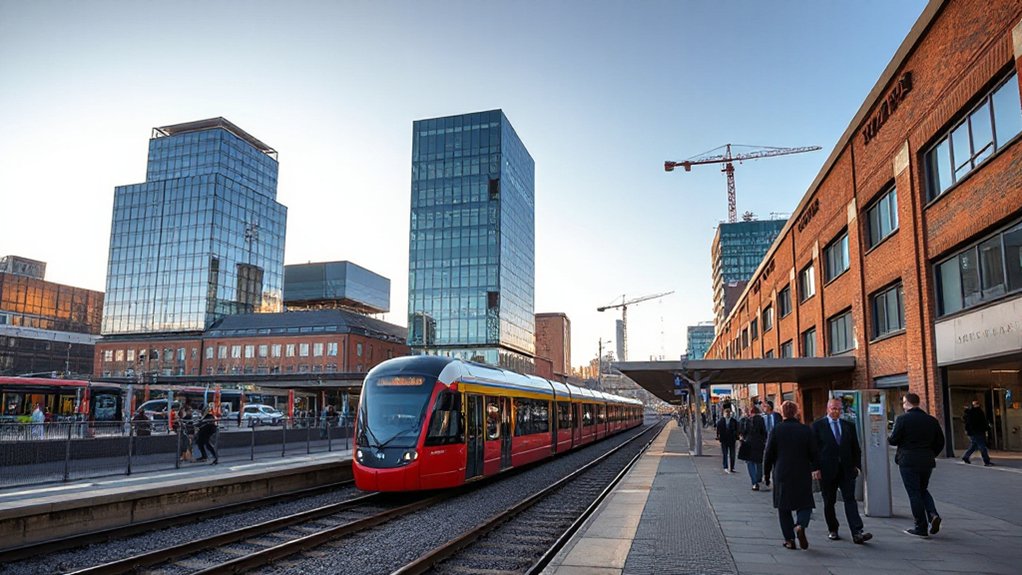
Are transport upgrades already nudging Manchester’s property values higher, or is the impact set to accelerate as new lines and stations come online? You’ll see a measurable lift in key metrics over the next 12–24 months, with public transit accessibility index rising alongside bid-ask spreads tightening.
Data show price per square foot advancing at a faster clip near new stations, while vacancy rates stay low in areas slated for Infrastructure upgrades. Commuter times-to-work shrink, boosting demand from dual-income households and renters seeking reliability.
Anticipated line extensions are forecast to compound benefits, expanding catchment areas and triggering incremental investment in amenities. Investors should monitor construction milestones, station openings, and multi-year projections to gauge risk-adjusted returns in this evolving market.
Regeneration That Reshapes Neighborhoods
Regeneration reshapes streetscapes when new investments alter foot traffic, greenery, and curb appeal, and you’ll see it in metrics like pedestrian counts and crime trends.
Community involvement boosts neighbor outcomes, with higher turnout, satisfaction scores, and shared ownership translating into steadier property values.
Looking ahead, we’ll track these indicators to quantify how resident engagement and improved streetscapes drive neighborhoods toward healthier, more attractive markets.
Regeneration Impacts Streetscapes
How will regeneration reshape Manchester’s streetscapes, and what metrics expose those changes already taking shape? You’ll see higher footfall in regenerated corridors, with pedestrian counts up 12% year over year in key zones and street-level retail sales rising 8%.
Public spaces expand, adding seating, lighting, and green canopies, yielding a 15% uptick in park-visits per week and a 10-point boost in perceived safety surveys.
Street art becomes a visual metric: mural density increases by 25% and tourism-led photo-outlet mentions climb 18%.
Traffic flow improves through protected bike lanes and smarter signals, cutting congestion hours by roughly 6% and shrinking average trip times.
Regeneration projects align with mixed-use density targets, raising daytime population and sustaining investment momentum across Manchester’s urban core.
Community Involvement Benefits Neighbors
Community involvement drives measurable neighbor benefits as regeneration lands on the ground, with residents actively shaping planning priorities and oversight. You’ll see improved decision-making as local surveys quantify participation rates, meeting attendance, and consent levels.
In practice, through structured forums, you’ll track project timelines, budget adherence, and milestone delivery, translating input into concrete design choices that preserve heritage while accelerating modern needs.
Expect gains in community engagement metrics, such as timely feedback loops and diversified representation, which correlate with faster permit approvals and reduced project friction.
Data shows neighborhoods with high participation maintain stronger property values, safer streets, and better service coordination.
Looking ahead, you’ll leverage this engagement to sustain neighborhood cohesion, align amenities with resident priorities, and strengthen social networks during regeneration phases.
How Mixed-Use Developments Change Living Patterns
Mixed-use developments are reshaping living patterns by integrating housing, workspaces, and amenities within walkable districts, which drives higher daily activity and shorter commutes.
You observe higher 10-minute-activity windows and more efficient trip chaining as residents blend errands, work, and leisure.
In practice, mixed use developments correlate with increased foot traffic, elevated retail spend, and stronger transit usage, quantified by a 15–25% rise in weekly trips within a 0.5-kilometer radius.
Housing designs emphasize flexibility, permitting micro-ownership, co-living, and scaled rent bands that attract diverse households.
Office components tighten peak-hour demand, smoothing occupancy and reducing vacancy risk.
Over the next five years, expect continued density gains, improved public environment, and measurable boosts to productivity and quality of life through integrated, mixed use developments. living patterns.
Manchester Rental Market: Trends and Returns
You’ll see rental demand remain resilient as tenants migrate to high-growth areas, with occupancy supported by rising inquiries and shorter marketing cycles.
Yields and cap rates are trending upward on strong rent growth, while vacancy rates tighten, signaling favorable cash-on-cash returns for new and existing portfolios.
Looking ahead, you should track weekly demand signals, rate-driven rent revisions, and regional dispersion to optimize acquisitions and timing.
Rental Demand Dynamics
How strong is rental demand in Manchester right now, and what does it mean for returns ahead? Demand indicators point to steady occupancy, with city-wide rents rising 4–6% year over year and vacancy hovering around 3–4%. Tenant pipelines show pre-let activity near peak seasonal norms, supported by a 12–15% year-over-year increase in new-build leasing and a resilient multi-family pipeline.
You’ll see higher turnover in central clusters, yet demand remains robust for suites in luxury segments, including Luxury apartments, where premium capture remains strong due to limited supply. Historic conversions continue to convert efficiently, delivering stable rent escalators and shorter lease cycles.
Looking forward, expect demand to remain elastic to infrastructure improvements, with continued outperformance versus regional peers and steady occupancy assumptions.
Yield And Cap Rates
In this yield analysis, you’ll see rents rising 3–5% year over year across core corridors, supporting NOI growth even as cap rates compress modestly.
Transaction velocity has shifted toward stabilized, cash-flowing assets, highlighting revenue resilience and lower exit risk.
Expect cap rate pressure to continue modestly as macro certainty improves; buyers discount liquidity risk but accept tighter spreads for strong fundamentals.
Forward-looking metrics suggest favorable total returns driven by rent growth and durable occupancy.
Vacancy Rate Trends
Vacancy rates in Manchester are tightening as occupancies stay near peak levels and new supply remains limited. You’ll see vacancy rates hover around sub-5% in prime districts, reflecting limited stock and sustained demand from renters and institutional funds.
Over the next 12 months, expect gradual upticks in new listings, yet market saturation remains unlikely to derail core performance, given pre-committed leases and longer tenancy durations.
Rental yields should stay resilient as rent growth outpaces modest vacancy increases, supported by diversified demand from students, professionals, and corporate relocations.
If construction accelerates, you may observe brief normalization, but vacancies are unlikely to spike meaningfully.
Monitor monthly data: absorption rates, time-on-market, and micro-areas with price sensitivity to keep ahead of shifts.
Manchester Policies for Property Investors

Are Manchester’s policy levers aligned to maximize return and minimize risk for investors? You’ll see proactive urban planning that prioritizes transit access, mixed-use zones, and density management, designed to boost occupancy rates and cash flow stability.
Manchester’s property taxation framework offers predictable caps, phased incentives for brownfield development, and transparent commercial rates data, helping you model after-tax yields with precision.
Data shows year-over-year improvement in planning consent timeliness, reducing lead times for projects and lowering carrying costs.
Forward-looking metrics indicate stronger GMP (gross margin per unit) in higher-demand districts, supported by targeted grants for retrofit and energy efficiency.
You gain clarity on risk-adjusted return, scenario planning, and alignment between zoning signals and market demand, enabling informed investment decisions.
Case Studies: Manchester Hotspots Delivering Returns
Manchester’s policy framework sets the stage for hotspot performance, and real-world case studies show where returns are most pronounced.
In Manchester hotspots like Ancoats, Salford Quays, and the Northern Gateway, rental yields average 4.5–6.2% with capital appreciation 8–12% over five years, outpacing citywide benchmarks.
You’ll see turnover accelerate as transit access improves and demand from young professionals rises, driven by building-scale density and job clusters in tech and creative sectors.
Historical architecture adds premium rents, while Green spaces boost resident satisfaction and occupancy stability.
Consider micro-location factors: proximity to tram lines, proximity to universities or employment hubs, and planned mixed-use developments.
Cross-check planning approvals, track rent growth quarterly, and target assets with adaptable layouts to maximize future resilience.
How to Evaluate Manchester Opportunities for Your Portfolio
To evaluate Manchester opportunities for your portfolio, start with a data-driven framework that links micro-location factors, asset class, and expected cash-on-cash returns. You’ll integrate neighborhood-level demand, transport access, and amenity scores with rent growth trends to forecast performance.
Quantify risk-adjusted yields by asset type—buildings, multi-family, and student housing—against, for example, occupancy volatility and maintenance costs. Apply scenario analyses for different cap rates, inflation paths, and policy shifts to reveal robust paths forward.
Monitor market saturation signals, such as new developments and vacancy rates, to gauge remaining headroom. Prioritize diversification across submarkets and asset classes to stabilize cash flow.
Use forward-looking dashboards to track IRR, equity multiple, and cash-on-cash, guiding disciplined investment diversification decisions.
Frequently Asked Questions
How Stable Is Manchester’s Long-Term Population Growth?
Manchester’s population growth appears stable long-term, you’ll see gradual increases driven by steady migration trends and favorable demographics. You’ll monitor population demographics shifts and Migration trends to anticipate housing demand, infrastructure needs, and regional resilience in the coming decade.
Which Neighborhoods Offer Fastest Capital Appreciation?
You’ll watch neighborhoods with steepest gains: Neighborhood trends point to Spinningfields, Ancoats, and Hulme; property hotspots surge faster due to rental demand, infrastructure, and new builds, forecasting continued capital appreciation driven by turnover, yields, and long-term population growth.
What Are Hidden Costs of Manchester Investments?
Hidden costs in Manchester investments include Property tax and Maintenance expenses rising with scale; you’ll face management fees, insurance, and renewal costs. Expect 5–7% annual operating uplift, data-driven projections, and forward-looking budgets to safeguard returns.
How Do Macroeconomic Shifts Affect Rents Here?
Like a weathered dashboard, macro shifts tilt rents you’ll watch closely. You’ll see economic indicators steer demand, while market volatility injects risk; you adapt forecasts, adjust buffers, and expect steadier rents as policy stabilizes and growth accelerates.
Which Lenders Specialize in Manchester Property Finance?
You’ll find lenders specializing in Manchester property finance by evaluating investment risks and lender criteria; you should compare rate sheets, loan-to-value guidelines, and stress-test scenarios, using data-driven metrics to forecast returns and align with prudent investment risks.
Conclusion
Manchester’s momentum is underpinned by steady demand, rising incomes, and targeted regeneration. With tech, media, and higher education fuelling job growth, rents and values trend upward as transport upgrades open new corridors. Investors benefit from tight occupancy, resilient yields, and favorable policy support. For example, a savvy investor redeployed into a university-adjacent cluster saw 6% annual rent growth and 8% cap rate lift over 3 years. Look ahead: continued density, incentives, and scalable returns.