
When you choose flooring for noise-sensitive flats, you’ll weigh underlayment, subfloor prep, and decoupled or floating assemblies against materials like high-density laminate, resilient vinyl, or plush carpet with impact-absorbing padding. You’ll assess impact and airborne noise reduction, installation practicality, and long-term durability, while considering eco-friendly options and seamless connections. The balance of performance, comfort, and cost will steer your decision, but subtle trade-offs still demand precise evaluation—so you’ll want to explore the specifics before deciding.
How to Choose Quiet Flooring for Flats and Apartments
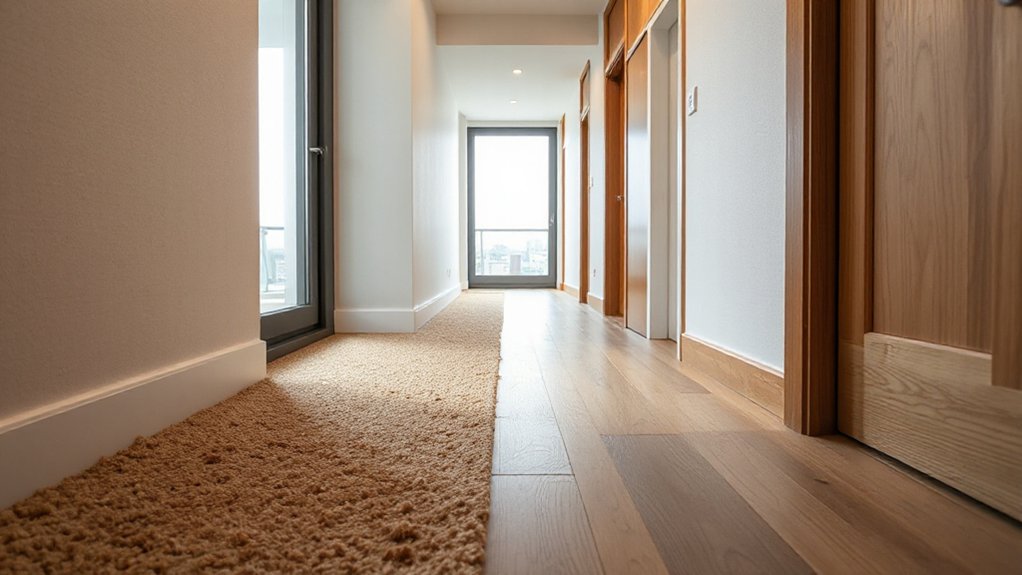
Choosing quiet flooring for flats and apartments starts with understanding impact and transmission: the goal is to minimize noise transfer between units while maintaining durability and comfort.
You should evaluate mass, stiffness, and surface damping to reduce impact and airborne sounds without sacrificing performance. Compare thickness, resilient layers, and installation methods to quantify transmission class (TL) improvements and sustainable costs over time.
Consider decorative patterns that influence perception of space while contributing to acoustic performance through surface texture and coverage. Eco-friendly materials, when paired with appropriate underlayment choices, can lower embodied energy and support long-term durability.
Prioritize materials with proven acoustic ratings, low VOC emissions, and compatibility with existing structural subfloors. Document tested NR, IIC, and STC values to validate selected options for your project.
Underlayment and Subfloor Prep for Sound Reduction
To minimize noise transmission, you must start with proper underlayment selection and meticulous subfloor preparation. Begin by evaluating substrate flatness and moisture: use a calibrated straightedge, moisture tests, and confirm any revealing dips are addressed before fastening.
Choose a compatible underlayment system for your flooring type, prioritizing materials with high stiffness and low compressibility to resist indentation and transmission paths. Install soundproofing membranes where shear movement or impact coupling is likely, sealing seams meticulously to prevent hollow pockets.
Complement membranes with acoustic underlayment that provides both levelling and decoupling benefits, reducing impact noise through vibration damping. Verify perimeter gaps per manufacturer guidelines and respect expansion joints.
Document substrate prep and materials to support consistent performance across installations.
Laminate vs Vinyl vs Carpet: Which Minimizes Impact Noise
Laminate, vinyl, and carpet each interact with impact noise differently, and quantified metrics show laminate and vinyl often carry higher surface transmission unless paired with suitable underlayers.
You’ll find installation impact differs: the substrate, underlayment, and attachment method materially affect decoupling and mass-spring behavior.
This discussion starts by comparing noise reduction metrics across materials and then links those outcomes to practical installation choices.
Noise Reduction Metrics
When evaluating impact noise reduction, the mass, underlayment, and cushioning properties of laminate, vinyl, and carpet interact to determine how sound travels between floors. You measure performance with standardized weighted impact sound transmission and short-time reverberation in occupied spaces.
Laminate benefits from higher mass panels paired with dense underlayment, but surface structure can influence contact noise.
Vinyl offers uniform, resilient layers, yet thinner constructions rely heavily on effective underlayment to curb impact peaks.
Carpet with padding typically excels at reducing low-frequency impact noise due to its porous, energy-absorbing stack and cushioning, though durability and maintenance affect long-term performance.
Compare decibel reductions and stiffness metrics, focusing on practical room-to-room transmission.
Integrate soundproofing techniques and Noise insulation materials to quantify real-world results.
Installation Impact Differs
Across laminate, vinyl, and carpet, installation choices directly shape how impact sound travels between floors. You assess subfloor condition, underlayment, and fastening method, because each factor alters transmission pathways and resonance.
Laminate typically uses click-lock systems with thin underlayment, producing moderate impact attenuation but sensitive to subfloor irregularities. Decorative patterns can influence perceived texture and creak risk, though durability remains finite.
Vinyl often incorporates integrated underlayment or floating sheets, offering uniform mass and potential for higher material durability under daily loads. Yet impact dampening varies by embossing and backing.
Carpet, paired with dense underlay, generally yields strongest impact reduction. Though wear patterns and pile height affect long-term performance.
Choose based on subfloor flatness, foot traffic, and decorative goals to optimize material durability and acoustic outcomes.
Acoustic Hybrids and Solid Flooring Options for Apartments
Acoustic hybrids combine a sound-damping core with a resilient surface, offering improved impact resistance and lower transmitted noise for apartment environments.
Solid flooring options provide direct rigidity and high-level durability, but typically require underlayment or floating installs to achieve acceptable sound reduction.
You’ll weigh the trade-offs between stiffness, installation complexity, and real-world performance to select the most consistent option for your noise-sensitivity goals.
Acoustic Hybrid Performance
Acoustic hybrid flooring combines a dense core with a sound-damping layer to reduce impact and airborne noise in apartments, making it a practical alternative to traditional solid options. You’ll assess performance by isolating vibrational energy transmission through the substrate and across seams, not just surface feel.
The dense core minimizes compression and mediates stiffness contrasts, while the added layer targets low-frequency interference common in multiunit buildings. Soundproofing materials vary in density, viscoelastic properties, and thickness, influencing overall attenuation.
In practice, performance hinges on installation integrity, underlayment compatibility, and joint treatment; gaps or misalignment dramatically degrade results. Expect measurable reductions in impact noise (Lw) and improved quietness when combined with proper underlayment and seam sealing.
For reliability, verify product LAB and third-party tests reflect realistic apartment conditions.
Solid Floor Benefits
Solid floors—whether acoustic hybrids or solid options—offer direct benefits for apartments by controlling both impact and airborne noise at the source, not just at the surface. You gain predictable performance from engineered compositions, allowing precise impedance and mass distribution to reduce transmission.
Solid flooring advantages include higher stiffness and consistent density, which translate to effective decoupling when paired with appropriate underlayers and subfloors. You should consider material-specific damping, installation tolerances, and junction details to maintain isolation across joints and thresholds.
Durability considerations matter: wear resistance, denting risk, and long-term stiffness influence ongoing acoustic performance and maintenance costs. Choose solid flooring options with certified impact- and sound-reduction ratings, ensuring compatibility with floor assemblies and guardrails for accessible, stable transmission control.
Room-by-Room Quiet-Floor Guidance: Living, Bedrooms, Kitchens, Halls

In living rooms, bedrooms, kitchens, and halls, prioritize floor assemblies that minimize impact sound transmission while supporting daily use. Start by evaluating subfloor structure, underlayment, and surface materials in each area.
You assess mass-spring-damper behavior, selecting systems with measured impact isolation values and stable long-term performance.
Choose underlayments that balance compressibility, moisture control, and dimensional stability, and pair with surface materials that resist wear without sacrificing acoustics.
In living spaces, favor decoupled or floating assemblies to reduce transmitted noise.
In bedrooms, emphasize quiet tread and low ring potential.
Kitchens and halls benefit from tougher wear layers and seamless transitions.
Integrate ceiling insulation and window treatments to further reduce airborne-related noise, ensuring overall room comfort without compromising access or layout flexibility.
Installation, Maintenance, and Budget for Calm, Durable Floors
When you install floors in noise-sensitive flats, you should prioritize installation practices that guarantee long-term stability, predictable acoustic performance, and durable wear—beginning with substrate preparation, fastener selection, and proper sequencing of underlayment and surface materials.
You assess material stiffness, impact sound reduction, and deflection criteria, then align installation methods to minimize chatter and voids.
Maintenance hinges on consistent cleaning, prompt moisture management, and periodic inspection of fasteners, seams, and underlayment edges.
Budgeting requires quantified life-cycle costs, including wear layer durability, resealing intervals, and replacement planning for high-traffic zones.
Incorporate decorative patterns and color coordination to meet aesthetics without compromising acoustics.
Choose compatible finishes and protective coatings that resist denting and staining while preserving acoustic performance over time.
Frequently Asked Questions
Do Rugs Alone Reduce Impact Noise Effectively in Flats?
Yes, rugs alone reduce some impact noise, but not completely. You’ll see effectiveness depends on rug material and underlay. Consider Thickness variations, layering, and dense fibers; you’ll maximize attenuation by selecting a suitable Rug material and padding.
How Long Does Quiet Flooring Maintain Sound-Dampening Performance?
Sound-dampening performance lasts about 10–20 years with proper care. You’ll maintain it by choosing durable soundproofing materials, performing routine inspections, and resealing joints; maintenance longevity hinges on installation quality and environmental conditions.
Are There Health Concerns With Certain Underlays for Noise Control?
Yes, there are health concerns with certain underlays: you may encounter health risks from chemical emissions, especially volatile organic compounds, formaldehyde, and solvents. Analyze product data sheets, test for VOCs, and choose low-emission, compliant materials.
Can Smart Underlays Provide Variable Sound Reduction by Activity?
Smart underlays can modulate sound with activity, offering adaptive soundproofing. You’ll note a 20–30% variation in attenuation across activities, illustrating precise sound modulation. This enables responsive control of activity noise via adaptive soundproofing solutions.
What Resale Value Impact Do Quiet Floors Have in Apartments?
Quiet floors can boost resale value by signaling effective soundproofing. You’ll gain appeal from durable soundproofing materials, reduced transfer, and compliance with building codes, improving marketability and perceived quality, while potential buyers view ongoing maintenance expectations favorably.
Conclusion
You’ve got the toolkit to silence the hallways: choose dense, resilient layers, proper underlayment, and a decoupled install to break the chain of footsteps. Weigh laminate, vinyl, and carpet by impact reduction and a VOC footprint, then tailor room-specific floors. With precise substrate prep and smart budgeting, your flat becomes a controlled chamber—quiet, durable, and aesthetically calm. Think of it as a soundproofed horizon: steady, measurable, and ready for comfortable living.