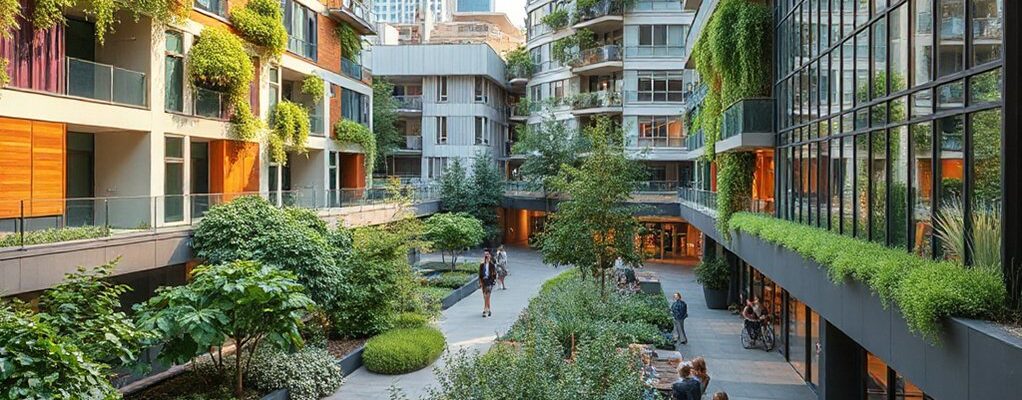
You’re shaping cities where regeneration zones turn data into action, guiding green mobility, housing, and local jobs with measurable outcomes. You’ll see how cross-disciplinary teams blend urban design, finance, and climate science to cut emissions, boost equity, and strengthen resilience. The picture is advancing steadily, yet the next move—syncing community voices with adaptive governance and funding—will determine whether these zones truly redefine everyday life. The path forward invites deeper inquiry into what comes next.
Key Takeaways
- Regeneration zones align housing, jobs, and green space via data dashboards, enhancing affordability, resilience, and climate adaptation citywide.
- Cross-sector collaboration and rapid feedback foster transparent governance, scalable urban growth, and culturally preserving place identities.
- Shared amenities and public realm networks reduce crowding, cut costs, and boost health, safety, and social cohesion through data-informed design.
- Corridor redevelopment and mobility strategies optimize street space, multimodal access, and safety while preserving cultural heritage.
- Innovative financing and inclusive governance leverage blended funds and microbusiness supports to sustain equitable urban renewal.
What Regeneration Zones Are and Why They Matter

Regeneration zones are designated urban areas where investments, policies, and design strategies converge to renew housing, economy, and ecosystems.
You engage with data dashboards that track housing affordability, job growth, and green space expansion, and you see how cross-sector collaboration accelerates outcomes.
These zones optimize land use, infrastructure, and services to reduce commute times, emissions, and energy intensity.
You measure success through urban resilience indicators, like flood mitigation, heat mitigation, and disaster preparedness, while aligning with cultural preservation goals that honor local heritage and arts.
The approach is interdisciplinary, combining urban planning, economics, ecology, and social equity to close gaps in access and opportunity.
You act proactively, stitching finance, governance, and community voice into a scalable, replicable model.
Core Principles for Regeneration Zones
You begin by anchoring regeneration in community origins and scalable growth, using clear metrics to track social and economic impact.
You integrate cross-disciplinary insights—from urban design to economics—to shape a framework that prioritizes people, place, and performance.
You keep the focus tight on actionable principles that align community formation with sustainable outcomes and measurable progress.
Community Beginnings And Growth
Community beginnings set the tone for sustainable growth by aligning local assets, resident needs, and external investments from day one. You map data across housing, transportation, green space, and micro‑business potential to identify leverage points that accelerate early wins.
You design inclusive outreach cycles that translate surveys into concrete pilots, then measure progress with dashboards showing housing affordability, job creation, and access to services.
You mobilize cross‑disciplinary teams—urbanists, economists, ecologists, and sociologists—to foresee tradeoffs and optimize outcomes.
You foster Community engagement through transparent decision rails, shared leadership, and rapid feedback loops, ensuring residents shape project choices rather than react to them.
You honor cultural preservation by integrating local narratives, arts programming, and heritage sites into planning, elevating identity alongside growth.
Sustainable-Focused Frameworks
You build a framework that prioritizes transparency, metrics, and adaptive governance, so progress is trackable and repeatable.
You’ll align energy efficiency with climate resilience, optimize mobility to reduce congestion, and target housing stability through inclusive zoning and performance measures.
Urban art and cultural hubs become accelerators for engagement, signaling transformation while preserving identity.
Data informs risk, opportunity, and investment plans, ensuring equitable benefit distribution across neighborhoods.
You’ll formalize partnerships between researchers, practitioners, and residents, embedding continuous learning loops.
The result is a proactive, interdisciplinary playbook that scales sustainable outcomes without compromising cultural crucial.
From Blight to Mobility: A Practical Corridor Redevelopment Framework
You’ll examine corridor mobility flows to identify where blight concentrates and where redevelopment can restore connectivity.
Ground your assessment in cross-disciplinary data—from traffic patterns to health and economic indicators—and outline concrete blight-to-mobility steps that align with a practical redevelopment framework.
Corridor Analyzes Mobility Flows
Corridor analysis maps how people and goods move through a place, turning traffic counts, land use, and street design into actionable mobility insights. You’ll synthesize data from sensors, transit schedules, and pedestrian counts to identify flow bottlenecks, seasonal shifts, and multimodal crossing gaps.
By layering land use and economic activity, you reveal how destinations cluster and how disruption ripples across neighborhoods. This is a proactive, interdisciplinary process: engineers, planners, and community voices align around measurable mobility outcomes.
You’ll test scenarios that optimize street space, reduce vehicle miles traveled, and improve safety. Emphasize innovative zoning as a lever for density and mix, while weaving community storytelling into dashboards to reflect lived experience and shift public buy-in toward regenerative corridors.
Actionable metrics replace guesswork, accelerating practical, equitable mobility improvements.
Blight-to-Mobility Redevelopment Steps
Blight to mobility isn’t just about removing degraded blocks; it’s about converting failure into function through a structured redevelopment workflow. You begin with diagnostic mapping that quantifies vacancy, infestation, and service gaps, then translate data into a phased action plan.
Prioritize safety corridors, public domain upgrades, and multimodal investments that preserve street grids while accessing new mobility layers. Engage engineers, planners, and cultural stewards to align infrastructure with urban resilience goals, ensuring climate adaptation and redundancy across utility, transit, and pedestrian networks.
Establish performance metrics focused on time, cost, and user experience, adjusting routes and densities as conditions evolve. Protect cultural preservation by integrating historic facades, place identities, and community memories into design palettes.
Converge public input with technical rigor to sustain equitable, efficient mobility outcomes. Urban resilience remains your north star.
Practical Redevelopment Frameworks Applied
Practical redevelopment frameworks translate the Blight-to-Mobility blueprint into repeatable, data-driven steps that any corridor team can implement. You map current conditions with geospatial analysis, traffic patterns, and land-use surveys to identify high-priority nodes and constraints.
Then you shape a modular toolkit: small-scale interventions, phased capital plans, and performance metrics that align with both social equity and economic vibrancy. You design governance cadences that integrate cross-disciplinary teams—urban design, transportation, public health, and cultural services—for rapid feedback loops.
You embed urban art and cultural preservation into placemaking, ensuring authenticity while tracking outcomes like mobility, safety, and investment. Finally, you iterate with pilots, scale successful models, and publish benchmarks so other corridors can reproduce the gains.
Housing, Jobs, and Green Space: The Integrated Trinity
Housing, jobs, and green space form an integrated triangle where accessible employment, diverse housing options, and high-quality outdoor amenities reinforce each other. You’ll see how mixed-use zoning, transit accessibility, and park networks lift performance metrics across districts, from vacancy rates to health indicators.
Data show that proximity to jobs reduces commute times, lowers emissions, and boosts local retail significance, while varied housing sustains inclusion and stabilizes neighborhoods.
Green space enhances heat mitigation, air quality, and mental well-being, supporting urban resilience during shocks.
Cultural preservation threads through design choices, ensuring historic cores remain vibrant.
An interdisciplinary approach aligns planning, finance, and community input, creating adaptable ecosystems.
Proactive governance accelerates outcomes, turning the Trinity into a measurable driver of sustainable, prosperous city life.
Energy-Positive Homes Within Regeneration Zones
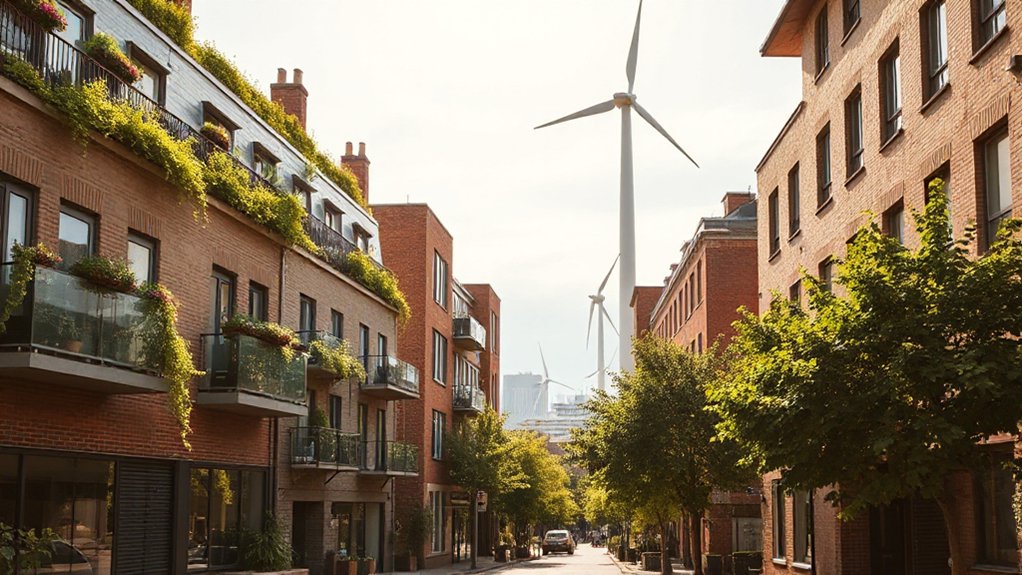
Data show higher retrofit uptake when design integrates efficient envelopes, demand-response controls, and durable materials, boosting neighborhood stability. Interdisciplinary teams—engineers, planners, and social scientists—prioritize urban aesthetics without compromising efficiency, blending solar facades with contextually sensitive forms.
Cultural preservation informs material choices, color palettes, and craft techniques that respect history while enabling modernization. You pilot pilots across districts, measuring lifecycle emissions, air quality, and energy equity.
The result: scalable models that empower communities, reduce bills, and illuminate the path toward regenerative urban living.
Shared Amenities and Public Realm: Co-ops, Parks, and Commons
You’ll examine how Shared Amenities Networks and Public Sphere Collaborations shape residents’ daily experiences, from co-ops to parks and commons.
The discussion will tie data from housing, urban ecology, and social policy to real-world outcomes like access, cost, and civic engagement.
Shared Amenities Networks
By coordinating shared spaces, you reduce crowding, lower costs, and boost neighborhood stability through predictable maintenance and governance models. You’ll measure outcomes across health, safety, and social cohesion, linking park significance to foot traffic and micro-economies within co-ops.
This interdisciplinary approach blends urban planning, sociology, and public health to validate decisions with metrics rather than anecdotes. You empower communities to shape rules, celebrate cultural preservation, and sustain local identities while maintaining universal accessibility.
The result is scalable, adaptable networks that densify resilience without sacrificing inclusivity or dignity.
Public Realm Collaborations
Public domain collaborations bring together co-ops, parks, and commons to shape livable, data-informed neighborhoods. You explore how shared amenities become accelerators for resilience and inclusion, with metrics guiding co-op formation, park programming, and commons governance.
Data streams—usage, accessibility, and environmental sensors—inform decisions, reduce friction, and reveal equity gaps. You’ll align interdisciplinary teams—urban designers, historians, technologists, and residents—in a cycle of co-creation, evaluation, and iteration.
Urban art emerges as a connective tissue, translating complex data into legible narratives that spark participation and pride. Community storytelling deepens trust, validating priorities through lived experience and observations.
Proactive collaboration surfaces adaptable models: modular parks, cooperative utilities, and open commons that scale with demand while preserving public value.
Transit and Mobility: Designing Walkable, Connected Neighbourhoods
Transit and mobility in walkable, connected neighborhoods hinge on integrated planning that pairs street design with real-time data. You map pedestrian flows, transit reliability, and micro-mobility usage to identify bottlenecks and safety gaps.
Data-driven corridors emerge where street grids prioritize protected crossings, curbside management, and predictable wait times, reducing car dependency. Smart infrastructure enables adaptive signaling and real-time wayfinding, aligning routes with demand and weather conditions.
Interdisciplinary teams—urban planners, engineers, public health experts, economists—co-create networks that support affordable access to jobs, schools, and services.
Cultural preservation informs street character, storefront vibrancy, and heritage-informed placemaking, ensuring changes respect identity while improving mobility.
You test interventions with pilots, monitor outcomes, and iterate for inclusive, resilient urban life.
Financing Regeneration: Models, Tools, and Risk Management
Financing regeneration requires a toolkit of models, tools, and risk-management practices that translate vision into viable, scalable investment. You evaluate blended finance, public-private partnerships, and outcome-based contracts to align incentives with measurable social, environmental, and economic targets.
Data dashboards, scenario modeling, and cost-benefit analyses guide you toward transparent disclosures and adaptive budgeting. Innovative financing channels—green bonds, tax increment financing, and impact funds—help you diversify risk and attract long-horizon capital.
You implement risk mitigation through covenants, reserve accounts, and early-warning indicators that reduce exposure to market swings and policy shifts. Interdisciplinary collaboration with urban planners, engineers, and economists sharpens project finance cases, accelerates approvals, and strengthens stakeholder trust in regeneration outcomes.
Economic Resilience: Supporting Small Business and Local Investment
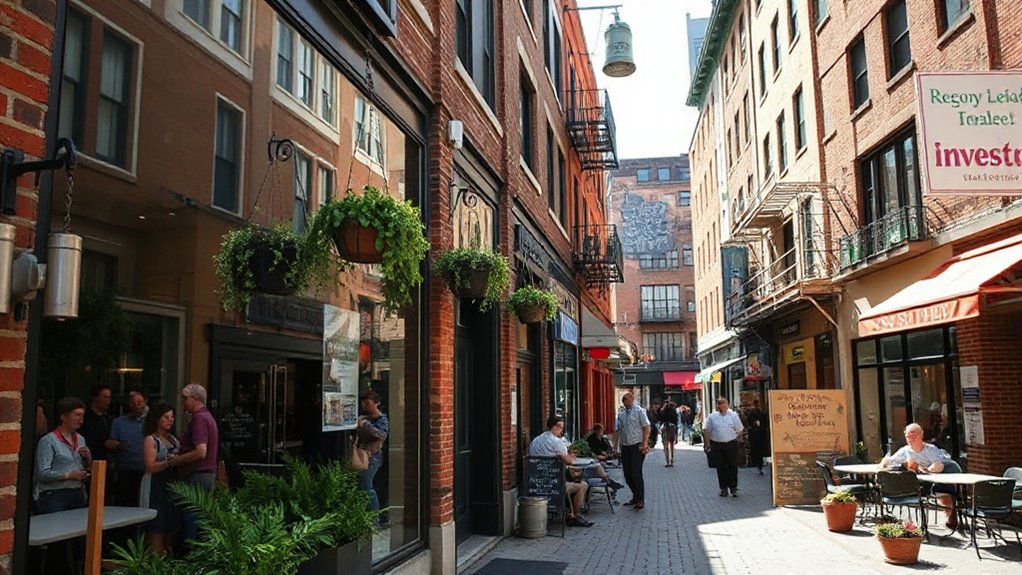
Economic resilience hinges on empowering local small businesses and catalyzing neighborhood investment. You drive this by aligning policy, finance, and community input to create a robust, mixed-use ecosystem.
Data shows that districts with targeted microloans, storefront incubators, and streamlined permitting see higher survival rates for startups and faster job creation.
You should leverage public–private partnerships to reduce risk and attract patient capital, while offering incentives for reusing vacant properties and digital storefronts that reach nearby residents.
Emphasize community engagement to tailor supports to neighborhood needs and to validate impact metrics in real time.
Your focus on Local entrepreneurship strengthens supplier networks, circulates capital locally, and multiplies local tax base, enabling reinvestment in services and infrastructure.
Social Inclusion in Regeneration: Designing for Diverse Communities
How do we design regeneration that centers all residents, especially underrepresented groups, from day one? You map demographics, incomes, and access gaps, then co-create metrics with communities to track progress.
You embed inclusive governance—trusted intermediaries, participatory budgeting, and multilingual outreach—so voices shape decisions from initial planning through delivery.
You design spaces and programs that honor cultural preservation, ensuring heritage sites, languages, and rituals are protected and celebrated alongside new amenities.
You promote proactive inclusion by funding culturally specific enterprises, childcare, and safe transit, reducing displacement risk.
You weave community storytelling into design briefs, dashboards, and public art, translating lived experience into measurable outcomes.
This interdisciplinary approach pairs data science, anthropology, and urban design to deliver equitable regeneration outcomes.
The Environmental Edge: Air, Water, Biodiversity, and Resilience
Healthy regeneration hinges on the environment you build around residents: air quality, water security, biodiversity, and resilient systems. In practice, you combine air monitoring with greenspace planning to reduce pollutants, heat, and noise, then pair water-sensitive design with drought-resilient layouts.
You quantify improvements through standardized metrics—PM2.5 reductions, stormwater capture rates, and groundwater recharge—and translate them into policy nudges and funding requests.
Interdisciplinary teams align urban greening with public health, ecology, and engineering to forecast outcomes under climate scenarios, enabling proactive upgrades rather than reactive fixes.
You prioritize ecological restoration to recover native habitats, bolster pollinators, and diversify species, enhancing ecosystem services.
Data-driven action supports transparent governance, community buy-in, and measurable resilience against shocks. This approach strengthens climate adaptation while maintaining liveability and equity.
Measuring Regeneration: How We Track Social, Economic, and Environmental Outcomes
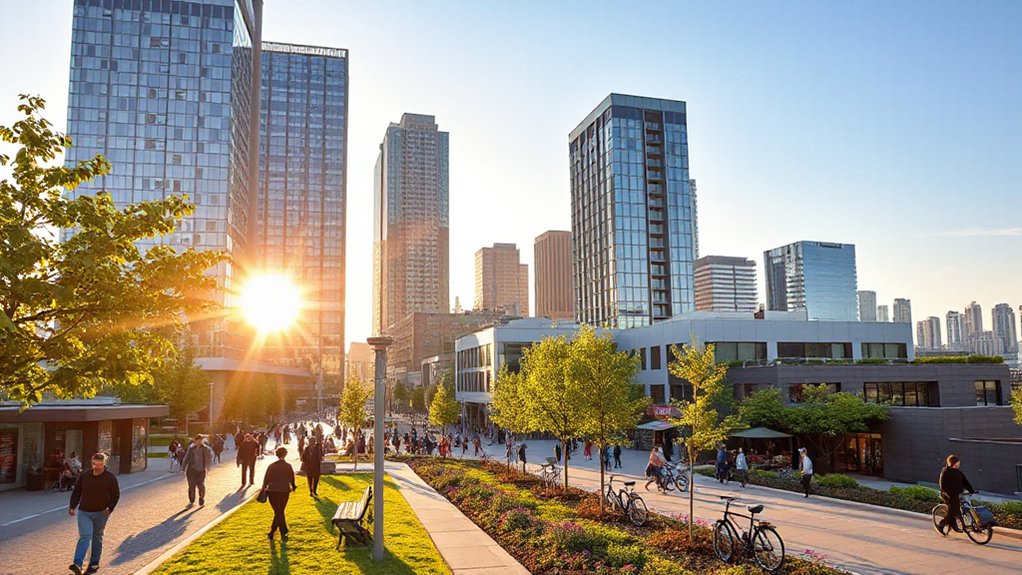
Measuring regeneration means turning outcomes into actionable signals you can act on. You’ll gather multi‑source data—from surveys, tax records, and transit data to health and air-quality metrics—to form a holistic dashboard.
This is where social, economic, and environmental outcomes converge, so you’ll apply standardized indicators alongside context‑rich narratives. Track accessibility, affordable housing, and job quality to gauge social wellbeing; monitor business vitality, wage growth, and entrepreneurship to assess economic resilience; and measure green space, water quality, and biodiversity trends for environmental health.
Prioritize community engagement to guarantee signals reflect lived experiences, and embed cultural preservation into metrics to respect place and identity.
Use iterative targets, transparent methodologies, and cross‑disciplinary review to drive evidence‑based policy and proactive adjustments.
Frequently Asked Questions
How Do Regeneration Zones Address Cultural Heritage Preservation?
You address cultural heritage by prioritizing cultural continuity and heritage conservation, integrating local histories into planning, financing durable preservation, and monitoring outcomes with data-driven metrics, interdisciplinary expertise, and proactive stakeholder engagement. You protect identities while guiding sustainable regeneration.
What Safety Standards Govern Shared Living and Co-Ops?
Safety standards for shared living and co-ops center on code compliance, fire protection, accessibility, and occupant safety. Like a well-tuned engine, you’ll balance Affordable housing with rigorous Community engagement, data-driven oversight, and proactive risk management across facilities.
How Do Zones Mitigate Gentrification Risks Effectively?
Zones mitigate gentrification risks by preserving affordable housing and prioritizing community engagement, yielding data-driven strategies across housing, economics, and urban planning. You’ll see affordable housing protections expand, while proactive, interdisciplinary monitoring guides ongoing investments and equitable outcomes.
Can Regeneration Zones Adapt to Climate Migration Impacts?
You can expect regeneration zones to adapt to climate migration impacts, boosting climate resilience. With 60% of migrants seeking urban opportunities, you’ll witness proactive migration adaptation, data-driven planning, and interdisciplinary investments shaping resilient neighborhoods you depend on.
What Metrics Capture Long-Term Social Cohesion and Trust?
You measure long-term social cohesion and trust with consistent Community engagement metrics and Social resilience indicators, tracking participation, perceived safety, collaboration across groups, and adaptive capacity, using data-driven, interdisciplinary methods to proactively inform policies and urban regeneration strategies.
Conclusion
You’ll see the data consistently point to one truth: regeneration zones don’t just rebuild neighborhoods, they recalibrate opportunity. When housing, jobs, and green space co-evolve, residents gain predictable, healthier futures, and local economies gain durable resilience. By testing hypotheses across housing, mobility, and ecosystem metrics, you’ll reveal that inclusive design compounds benefits—equity expands, emissions drop, and small businesses thrive. The deeper meaning? sustainable urban futures emerge where collaboration, measurement, and adaptive governance converge.