
Consider a single UK outage where the lights, router, and fridge stay powered for 8–12 hours using a lithium-based home backup battery with pure sine wave output; you’ll want to assess capacity, runtimes, and safety standards before you commit. You’ll need to weigh UK weather, grid quirks, and regulatory compliance against cost and maintenance. This discussion helps you map exact needs to a system that stays reliable when it’s most needed, without overbuilding.
Deciding What You Need for UK Home Backup Power
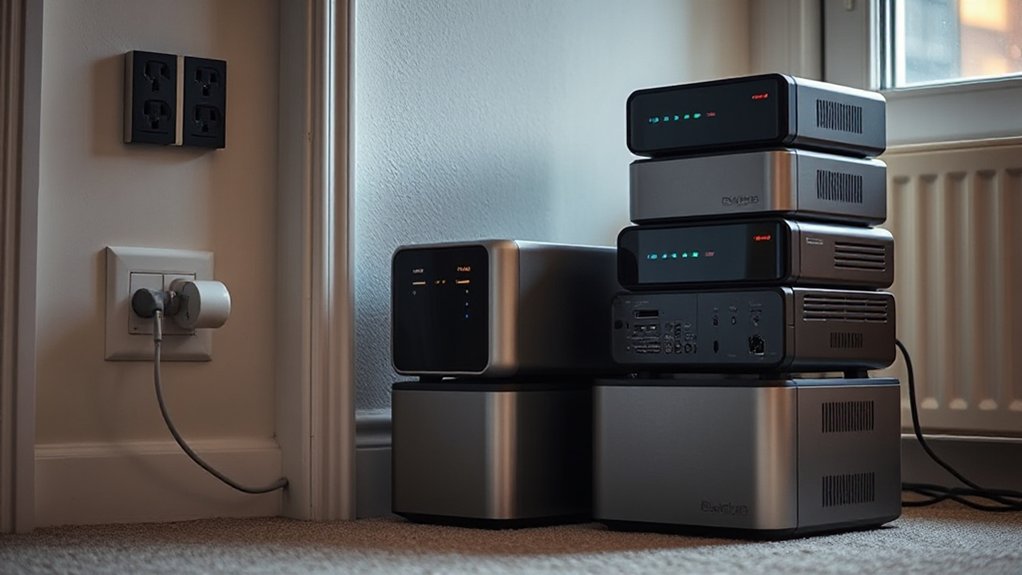
When sizing a UK home backup system, start by listing critical loads you must keep powered during an outage, then estimate anticipated duration and peak demand. You’ll map loads to feasible runtimes, balancing essential circuits with available battery capacity. Prioritize essentials (lighting, communications, refrigeration, heating control) and mark noncritical uses for discretionary shutdowns. Consider solar integration potential: daytime generation can reduce battery draw, extending run-time and lowering fuel needs, if you’re pairing with a hybrid approach. Assess duty cycles and startup surges, not just steady-state loads, to avoid undersizing. Evaluate fuel efficiency implications of generator-assisted backing, if applicable, against uninterrupted power supply performance. Input quality data, then iterate scenarios: winter stresses, maintenance windows, and grid-restoration delays, ensuring the system aligns with your reliability targets and budget.
How to Choose a UK-Ready Power Station: Capacity, Runtime, and Safety
When selecting a UK-ready power station, you start with capacity to match your essential loads and peak surges, ensuring the unit can sustain critical devices without overworking the battery. Then you evaluate runtime expectations, translating watt-hour ratings into actual backup durations for typical UK household scenarios. Finally, you verify safety standards and certifications to confirm enclosure integrity, thermal management, and compliance with UK electrical and consumer-safety requirements.
Capacity Considerations
Capacity determines whether a UK-ready power station can meet your essential loads. To assess viability, you perform capacity planning by totaling your critical appliances’ wattage and surge needs, then compare them against the unit’s continuous and peak power ratings. Focus on sustained (continuous) and peak (surge) outputs, not just nominal ratings, to avoid underestimating startup currents. Consider mix loads—heaters, pumps, fridges, and electronics—and apply a safety margin (typically 20–30%) to account for inrush and future additions. Verify that the battery or generator can sustain the required runtime for your most demanding period. Documentation should show derating factors for UK temperatures and UK-grid guidelines. Guarantee the system accommodates transfer switch compatibility and charging sources without compromising efficiency or safety.
Runtime Expectations
Runtime matters just as much as capacity: it tells you how long a power station can sustain critical loads between charges or fuel top-ups. You’ll gauge runtime by examining energy density, inverter efficiency, and battery management, then translate those metrics into practical expectations for home outages. Peak vs. continuous output matters: a unit may sustain essential circuits at lower load longer than it can sustain higher loads. Consider duty cycles, startup surges, and ambient temperature impacts, which influence real-world runtime. Energy efficiency drives usable runtime, reducing parasitic losses and extending available energy for critical loads. Look for architectures that support Renewable integration, enabling generation sources to augment stored energy during extended outages. Compare manufacturer runtimes under standardized load profiles to ensure you meet UK resilience goals without overestimating performance.
Safety Standards
Safety standards underpin UK readiness by ensuring equipment limits, protection features, and regulatory compliance align with domestic power needs. You assess safety by reviewing protections such as over‑current, short‑circuit, and thermal safeguards, plus appropriate isolation when connected to household circuits. Verify that installers and devices meet safety regulations and avoid DIY practices that bypass built‑in protections. Look for certification standards that confirm voltage, frequency stability, and automatic shutdown behavior under fault conditions. Consider enclosure durability, ingress protection for damp environments, and proper grounding to reduce shock risk. Guarantee battery modules include cell monitoring and temperature management to prevent thermal runaway. Documentation should specify compliance marks, test reports, and operating instructions, supporting safe, codes‑compliant use in home backup scenarios.
Best Compact Portable Power Stations for Essential Loads
For essential loads, compact portable power stations deliver reliable short-duration backup without bulk. You should evaluate capacity, inverter size, and peak power to guarantee compatibility with critical devices. Look for UPS-style rapid transfer and pure sine wave output to protect sensitive electronics. Battery chemistry matters: lithium iron phosphate offers longer cycle life and better thermal stability, while lithium polymer trades energy density for robustness. Charge options influence readiness: AC wall, 12V car, and portable solar can maintain readiness in outages. Consider real-world runtimes at 100–300W for lights, routers, and small medical devices; base expectations on device wattage and efficiency. Prioritize safety features, thermal management, and firmware updates. For essential loads, portability plus reliability trump excessive capacity when emergencies are brief, predictable, or intermittent. Emergency lighting remains a critical criterion.
Standalone Home Backup Batteries for All-Night Resilience
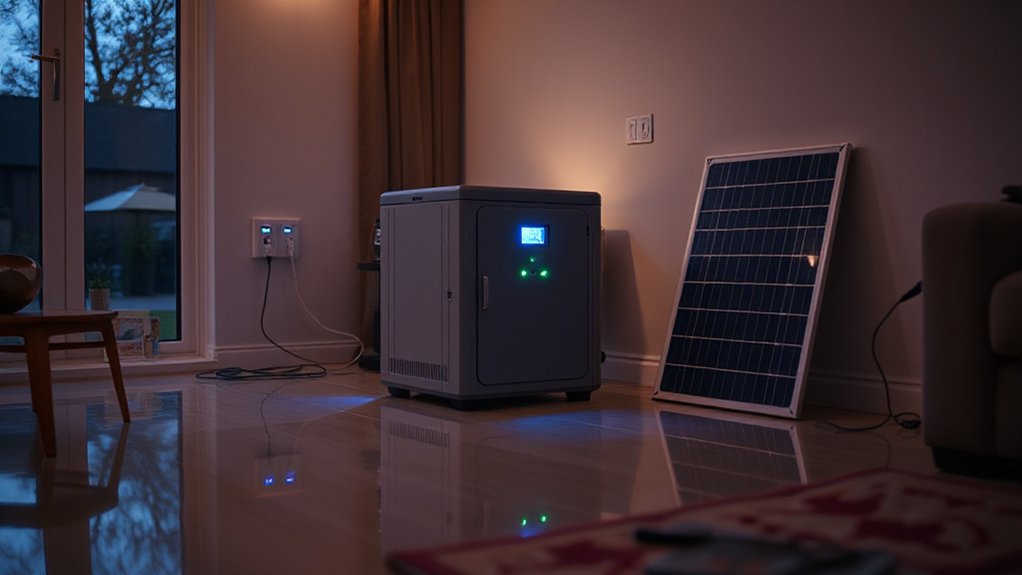
Standalone home backup batteries for all-night resilience demand a balance between capacity, longevity, and efficiency. You assess usable capacity, round-trip efficiency, and projected cycle life to guarantee continuous daytime power without excessive heat or standby loss. Battery chemistry choices influence charging speed, safety, and temperature tolerance, impacting nighttime performance and system sizing.
- Capacity vs. load profile accuracy for overnight autonomy
- Cycle life expectations under UK mains variations
- Thermal management to preserve efficiency
- Solar integration for daytime recharging efficiency
- End-of-life handling and battery recycling considerations
You also consider system monitoring, fault detection, and expansion pathways to avoid replacement costs. Prioritise modular packs, maintain warranty coverage, and align with regulatory standards. Sustainable design emphasizes solar integration and battery recycling to extend the overall value and lifecycle.
Generators vs Battery Systems: Pros, Cons, and Use Cases
Generators offer immediate power availability but with ongoing fuel and maintenance needs, whereas battery systems provide quiet, emissions-free operation with varying discharge rates and lifecycle costs. Use-case differences matter: rapid, short-duration outages may favor generators; prolonged resilience with installable storage favors batteries and hybrid approaches. This discussion compares reliability, efficiency, cost over time, and suitability for UK home backup scenarios.
Generators vs Battery Systems
When deciding between generators and battery systems for home backup, you should weigh immediate power availability, runtime predictability, and total cost of ownership.
- Generators deliver instant peaks but rely on fuel, increasing ongoing costs and emissions.
- Battery systems offer quieter, cleaner operation with modular scalability and predictable discharge curves.
- Renewable integration favors batteries for smoothing intermittency, while generators can back up when renewables dip.
- Noise levels and maintenance impact user experience and long-term viability.
- Total cost of ownership hinges on initial investment, fuel or electricity prices, and replacement cycles.
In practice, choose generators for high-load, emergency-only scenarios; batteries for daily resilience and seamless transitions. Consider hybrid setups to balance immediacy, cost, and sustainability.
Use Case Comparisons
Hybrid setups illustrate how generators and battery systems complement each other: you can deploy a generator for immediate high-load bursts or when fuel is readily available, while batteries provide quiet, predictable power delivery and seamless shifts during outages. In use-case terms, generators excel during peak demand or extended outages when continuous energy is needed, but incur fuel costs, maintenance, and audible signatures. Battery systems shine for short-duration outages, seamless transfer, and rapid response, with the advantage of silent operation and fast ramp rates. For Renewable integration, hybrids enable load smoothing and grid-tacing flexibility, reducing generator runtime. Noise reduction becomes a practical criterion when siting equipment inside living spaces or near offices. Consider duty cycles, target resilience, and seasonal variation to balance upfront costs against long-term reliability.
Real-World UK Considerations: Grid Quirks, Weather, and Safety
In the UK, grid quirks and weather patterns profoundly affect home power stations, so you must account for how mains supply limitations, charging windows, and grid stabilisation schemes interact with your backup plan. You assess reliability by timing charge cycles to off-peak windows and by understanding how voltage transients interact with inverter protection. Solar integration and grid independence drive design choices, not marketing hype.
- Monitor feeder constraints and notification schemes that trigger curtailment or ramping
- Plan for UK weather variance, including winter wind and summer sun fluctuations
- Prioritise safe isolation, earthing, and anti-islanding protections
- Schedule maintenance windows around grid restoration expectations
- Validate energy throughput under partial cloudy conditions to avoid outages
Plan, Size, and Price: Building Peace of Mind Into Your Setup
To plan, size, and price your backup system effectively, start by defining your critical load, acceptable autonomy, and target grid outage duration. Next, translate these metrics into a required power and energy budget, then assess runtime needs across worst-case scenarios. Size components to meet peak demand while factoring inverter efficiency, battery degradation, and future expansion. Price planning should compare capital expenditure, operating costs, and replacement cycles, aligning with expected outage frequency. Energy efficiency strategies reduce both initial and ongoing costs, so prioritize load shedding, smart sequencing, and appliance prioritization in your plan. Installation requirements must be clarified early— electrical clearance, ventilation, and isolation needs influence layout and safety. A precise, documented plan minimizes surprises and delivers predictable performance during outages.
Frequently Asked Questions
How Long Do UK Power Stations Hold a Charge in Storage?
You’ll typically see UK power stations hold a charge for weeks to months in storage, depending on battery type. Battery longevity depends on chemistry, while storage conditions—temperature, state of charge, and humidity—significantly affect performance and degradation rates.
Can Any Power Station Run on UK Mains for Charging?
Yes, you can, but not every unit. You’ll need solar compatibility and sufficient battery capacity; make sure your mains charging is supported, output is within spec, and charging efficiency remains acceptable under UK mains fluctuations.
Are UK Weather Conditions Accounted for in Warranty Terms?
Like a precise gauge, you’ll want to know: warranty coverage often excludes weather impact unless specified. You assess terms, confirm weather-related clauses, and guarantee coverage matches anticipated UK conditions before purchasing or filing a claim.
Do Portable Units Survive Damp or Coastal Air in the UK?
Yes, portable units resist damp, but you’ll see variability; check IP ratings and seals. In coastal air, expect faster wear from salty mist—prioritize damp resistance features and guard against coastal corrosion with protective coatings.
What’s the Resale Value After 5 Years in the UK Market?
You’ll likely see resale depreciation of around 40–60% and battery lifespan affecting value; coincidence favors durable cells. You’ll require maintenance records, confirm remaining warranty, and expect value to hinge on cycle life, usage, and regional demand.
Conclusion
You can’t cheat the weather, or the grid quirks, but you can outthink them. By sizing for your critical loads, prioritising lithium, pure sine wave inverters, and UK-compliant safety, you’ll build resilience you can trust. Think of your setup as a modern, quiet safe where you’re the unseen captain guiding power through outages. Plan, price, and maintain, and you’ll endure the night as reliably as the dawn. The future of standby power starts with deliberate choice.