
Did you know UK tap water quality varies more than you might expect between regions, affecting taste and mineral buildup? If you want clarity on what to filter, how media like activated carbon, KDF, or ceramic work, and which setup fits your home—from under-sink to pitcher options—you’ll want precise, data-backed guidance. Keep going to see how to compare filters by removal credits, flow rates, and total cost of ownership, so you can choose confidently.
Do You Need a Filter for UK Tap Water? How to Tell
If you’re considering a filter for UK tap water, you don’t always need one, but certain indicators justify it. You’ll assess water quality by measurable metrics rather than impressions alone. Start with pH data: a composition outside the neutral range (roughly 6.5–8.5) can signal system stress or corrosion risk, affecting household appliances and pipe longevity. Next, review Mineral content: elevated hardness or iron levels correlate with scale buildup or staining, influencing filtration choice. Look for official test results or local authority reports, and compare to product claims. Consider seasonal or district variation—one supply may shift after heavy rainfall or maintenance. Use a simple decision rule: if monitoring shows persistent deviations beyond baseline tolerances, a filtration solution targeting those metrics becomes warranted.
How UK Water Stacks Up: Common Contaminants and Why Filtration Helps
Water quality varies by region and over time, so understanding common contaminants helps you gauge filtration needs more accurately. UK tap water shows variability in mineral content and chemical additives, with measurable levels of chlorine used for disinfection and minerals contributing to water hardness. Filtration mitigates taste and health concerns by removing or reducing contaminants, improving consistent quality across supply zones. Here are key points:
- Water hardness influences scale potential and appliance efficiency.
- Chlorine levels affect taste and odor, and may form disinfection byproducts if residuals persist.
- Seasonal and regional shifts can alter contaminant profiles, demanding adaptable filtration.
- Post-treatment stability matters; guarantee cartridges address both taste and protection.
Choose filtration that targets both taste modifiers and mineral control to maintain consistent UK water quality.
How to Choose a Filter: Media, Cartridges, and Installation Basics
When selecting a filter, start with media types and cartridge design to match your water profile and usage. Media choices determine contaminant targets: activated carbon for organics, KDF for metals, remineralization for taste, and ceramic for particulate reduction. Cartridge construction affects flow, pressure drop, and lifetime; pair filter media with appropriate micron ratings to balance removal efficiency and maintenance intervals. Installation basics matter: verify inlet/outlet compatibility, orientation, and bypass compatibility for calibration. Consider whole-house versus point-of-use needs, flow rate, and pressure, then calculate service life using manufacturer-rated capacity and your tap water flow. For robust performance, align replacement schedules with your water hardness and contaminant levels. Remember: Filter maintenance and installation techniques directly influence sustained filtration efficacy and system longevity.
Brita-Style Cartridges vs Countertop Filters: Which Fits Your Home?
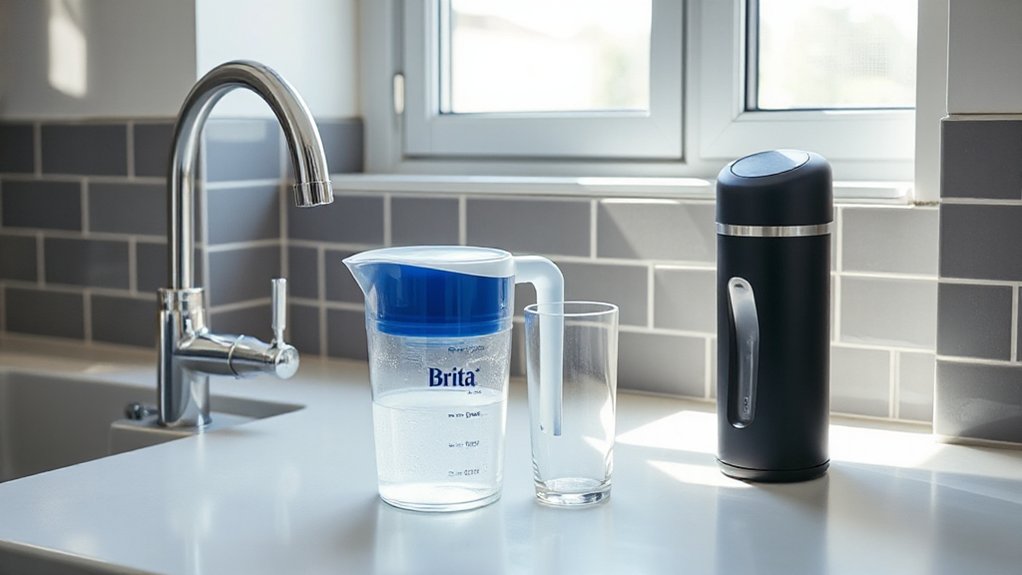
Brita-style cartridges and countertop filters each offer distinct trade-offs for home use, so your choice hinges on compatibility, maintenance, and water usage. Countertop models deliver higher flow rates and broader filtration media coverage, but require fixed placement and more frequent filter changes. Brita-style cartridges are compact, portable, and cost-efficient upfront, yet offer limited media diversity and lower filtration capacity per year. Your decision should weigh installation ease, replacement intervals, and compatible faucet or pitcher systems.
- Installation simplicity and hardware compatibility
- Filtration media variety and target contaminants
- Filter life, replacement cost, and frequency
- Impact on water taste and daily usage patterns
Consider water taste improvements versus ongoing upkeep when choosing the best fit for your home’s needs and tap water quality.
Under-Sink Filters: Balancing Convenience, Performance, and Cost
Under-sink filters must balance filter stages with space and fit in their cabinetry, ensuring you get effective contaminant removal without overhauling plumbing. You’ll compare the number of stages, flow rate, and filter lifespan to keep the total cost of ownership predictable for years, not months. This discussion starts by clarifying how each design choice impacts performance, space, and long-term expense.
Filter Stages Balance
Balancing convenience, performance, and cost in under-sink filter stages means evaluating how many filtration steps are necessary to achieve target contaminant removal while keeping flow rate acceptable and total cost reasonable over the system’s life. You weigh trade-offs between additional stages and marginal gains, focusing on overall system efficiency, flow, and replacement intervals. Practical guidance follows:
- Identify target contaminants and required removal percentages to determine necessary stages.
- Compare stage configurations for energy and flow-rate impacts, prioritizing essential barriers.
- Assess filter longevity and replacement costs to forecast lifecycle expense.
- Anticipate installation challenges and compatibility with existing plumbing and housings, avoiding over-specification.
Outcome: a tailored, cost-effective balance that preserves performance without unnecessary complexity.
Space and Fit
Efficient space planning is the first check for under-sink filters, since proper fit directly affects installability, maintenance access, and long-term usability. You’ll evaluate cabinet dimensions, clearance around shutoff valves, and filter housing depth to prevent interference with pipes and drawers. Control panels, filter leads, and drain lines should run with minimal bend radii to reduce pressure loss and leakage risk. Consider quick-release fittings and service access to minimize downtime during cartridge changes. Choose a compact, vertically oriented unit if space is constrained, and verify compatibility with existing inlet/outlet sizes. Assess long-term disposal impact; opt for systems with recyclable housings or simple Eco friendly disposal options. Note potential effects on Water mineralization and taste, ensuring the design keeps performance stable under routine use.
Cost of Ownership
Initial costs are only part of the equation: the true cost of ownership for under-sink filters combines cartridge price, replacement frequency, energy use, maintenance labor, and potential service fees. You’ll assess Water purity and Filtration technology trends to project ongoing expenses and performance. For each system, quantify total cost of ownership over 5–7 years, including downtime risk and filter stock. The following factors drive accuracy:
1) Cartridge price per liter of filtered water
2) Replacement interval based on usage and water hardness
3) Energy consumption for pump or flow control
4) Maintenance labor and potential service fees
Use data from independent tests to compare real-world performance versus advertised specs, ensuring durable efficiency and minimal lifecycle costs.
What UK Filters Remove (and What They Don’t): Contaminants by Method
Understanding which contaminants UK water filters target—and which they don’t—depends on the filtration method used. You’ll evaluate methods by mechanism: activated carbon adsorbs organic compounds and chlorine, improving taste and odor, but does not reliably remove dissolved salts or heavy metals at low concentrations. Ion exchange selectively replaces ions, reducing hardness and certain metals, yet it can introduce sodium or alter mineral content if not managed with post-treatment. Reverse osmosis delivers broad contaminant reduction, including salts, metals, and many organics, but requires pretreatment and yields wastewater with lower mineral content. Sub-mraction filtration and ceramic membranes excel at particulates and microorganisms, with variable chemical removal. pH adjustment and water mineralization may accompany these processes to stabilize taste and corrosion control, without compromising contaminant removal efficiency where specified.
Cost of Ownership: Upfront Costs, Replacement Parts, and Long-Term Value
When you compare filtration options in light of what contaminants they remove, you also weigh total cost of ownership: upfront costs, ongoing parts replacements, and long-term value.
- Upfront investment varies by technology, with countertop units often cheaper initially than under-sink hybrids.
- Replacement parts frequency and price directly affect annualized costs, especially for cartridges, filters, and membranes.
- System longevity and warranty terms influence long-term value, particularly for water softening and mineral removal performance.
- Disposal and maintenance tasks add minor yet cumulative expenses, including filter disposal and calibration checks.
Quick-Start Pathway: A Simple Shortlist for Your Needs
To quickly match the right filter setup to your needs, this shortlist pares options by core use case, contaminant focus, and installation style. You’ll see concise categories: taste-focused devices, contaminant-specific cartridges, and integrated under-sink or countertop kits. Each entry notes target contaminants, expected reduction levels, and flow implications, enabling data-driven comparisons at a glance. Water taste changes hinge on mineral retention and chlorine removal, so prioritize filtration myths when evaluating claims and verify certified performance. For kitchens with limited space, opt for compact under-sink units that maintain throughput without sacrificing contaminant reduction. If you prefer no installation drama, countertop pitchers with validated filters offer rapid assessment. Cross-check compatibility with your water pressure and confirm replacement part availability to sustain long-term performance.
Frequently Asked Questions
Are There Eco-Friendly Filter Options in the UK Market?
Eco friendly options exist in the UK market, with you prioritizing eco friendly materials and sustainable options. You’ll find filters using BPA-free plastics, recycled shells, and responsibly sourced carbon. You’ll compare efficiency, lifecycle impacts, and certified performance data.
Do Filters Affect pH or Mineral Content of Tap Water?
Filters can alter pH slightly and may cause mineral retention depending on media; expect minor pH alteration and variable mineral retention, not dramatic changes, with data showing modest shifts under typical household usage.
How Often Should UK Filters Be Replaced in Practice?
You should follow the manufacturer’s guidance for filter lifespan and replacement schedule, typically every 6–12 months or after a specified volume, depending on usage, water quality, and filter type; monitor indicator lights and conduct periodic performance checks.
Can Filtered Water Improve Taste for Coffee and Tea?
Filtered water can improve Coffee flavor and Tea freshness by reducing minerals and chlorine. You’ll notice cleaner aromas, steadier extraction, and more consistent flavors, as precise mineral balance enhances taste perception in hot brews and overall sensory clarity.
Are There Grants or Rebates for Home Water Filtration in the UK?
Grants and rebates exist in the UK, but availability varies by program. You can pursue home water grants and filtration rebates through local authorities, utilities, and schemes; eligibility depends on region, income, and project specifics, with documented cost-effectiveness.
Conclusion
You’ve got the data, now breathe it in like fresh rain on slate. With the right cartridge media and a smart install, you’ll kick chlorine and hardness to the curb while preserving flow. Think of your filter as a quiet dam: steady, precise, durable, and cost-aware over years. Weigh upfront and replacement costs, then match to your water’s quirks. In the end, you’ll drink clarity born of measured choice, not compromise.