Did you know that your heating controls can learn not just your schedule but how long rooms stay warm and how outdoor temps affect efficiency? You’ll use sensors, occupancy data, and weather forecasts to cut waste without sacrificing comfort, and you’ll want a system that scales with your home and renewables. The key is choosing the right balance of learning algorithms, zoning capabilities, and remote access—so you can optimize now and adapt later as conditions change.
Key Takeaways
- Choose energy-efficient smart heating controls that automatically modulate supply and setbacks based on occupancy, weather, and verified performance.
- Ensure interoperability, fault reporting, secure remote access, and continuous sensor calibration to maintain accuracy and speed.
- Integrate with renewables and home energy systems for real-time data, automated setpoints, and optimized charging/discharging.
- Implement adaptive learning thermostats that adjust schedules in real time and refine models with new data for comfort and savings.
- Prioritize zoning, proper sensor placement, and scalable upgrades (insulation, efficient pumps) to maximize ROI and long-term efficiency.
Define Energy-Efficient Smart Heating Controls
Energy-efficient smart heating controls optimize energy use while maintaining comfort. You define this class by combining sensing, control logic, and communication with the heating system.
You prioritize devices that modulate supply and setbacks automatically based on occupancy, weather, and verified performance, reducing energy waste without sacrificing comfort. You expect interoperability across standards, clear fault reporting, and secure remote access.
You evaluate Smart thermostat maintenance implications, ensuring sensors remain calibrated and firmware stays current to preserve accuracy and response speed.
You consider Heating system upgrades as part of total efficiency: condensing boilers, variable-speed pumps, and well-insulated distribution.
You quantify benefits with monitored energy use, indoor temperature stability, and reduced runtime, then validate results through periodic performance checks and documented maintenance histories.
Continuous optimization follows, not assumption.
How Learning Thermostats Adapt to Your Routine
Learning thermostats build a profile of your daily patterns by monitoring occupancy, activity, and outdoor conditions, then adjust heating schedules in real time to match your routine. As you use them, they learn your habits and predict needs, reducing waste and improving comfort.
You’ll notice faster adaptation when you modify your routine, since the device updates its model with recent data. These systems optimize setpoints by correlating occupancy signals with outdoor temperature and indoor heat loss.
They support continuous learning, refining responses to spikes in activity or extended absence. For effective results, guarantee robust heating system integration and reliable sensor placement.
When evaluating options, compare Smart thermostat brands for compatibility, update cadence, and data privacy. This approach delivers smoother progressions and energy efficiency without manual programming.
Zoned Heating 101: Targeted Comfort and Savings
Zoned heating splits a single system into dedicated areas, directing heat only where it’s needed to match occupancy and usage patterns. You’ll reduce waste by conditioning only occupied zones, improving comfort without oversized cycling.
Implementing zoning requires precise system zoning terms, dampers, actuators, and compatible thermostats. Smart thermostat placement matters: position sensors away from drafts, heat sources, and direct sunlight to reflect true room temperatures.
Tie each zone to a reasonable schedule that mirrors daily routines, then fine-tune setback and average-load targets to avoid overheating unoccupied spaces. Energy saving habits, such as conditioning spaces in sequence and avoiding simultaneous heating of adjoining zones, amplify gains.
Regular recalibration after occupancy changes preserves efficiency. Remember, zoning delivers targeted comfort, faster response, and measurable energy reductions when configured and maintained correctly.
Standalone vs Ecosystem: Which Platform Fits You?
Standalone systems offer simplicity and direct control but may limit future expansion.
While ecosystems emphasize compatibility and scalable features at the cost of broader lock-in.
Consider the practical trade-offs between standalone pros and cons and the ecosystem compatibility landscape to determine long-term flexibility versus integrated performance.
Your choice should align with future device plans, support expectations, and how you value interoperability today.
Standalone Pros and Cons
Standalone heating controls offer a simple, focused approach: you get direct, reliable management of a single thermostat or hub without relying on broader ecosystem integrations. You’ll appreciate straightforward setup, clear data access, and predictable behavior, with minimal cross‑device dependencies.
Pros include fast commissioning, lower cost per unit, and reduced risk from platform changes or vendor lock‑in. You can implement precise heating schedules and overrides without accounting for compatibility constraints.
However, cons appear as limited interoperability, fewer automation options, and potential manual updates when firmware evolves. If you value transparency and control over a discrete device, standalone systems deliver consistent performance.
For those prioritizing centralized control or multi‑device scenes, a broader ecosystem may offer richer functionality. Smart thermostats remain reliable tools when configured with clear heating schedules.
Ecosystem Compatibility Considerations
Choosing between a single-device approach and a broader ecosystem hinges on how you value interoperability, data access, and future-proofing.
In ecosystem scenarios, you gain unified control, deeper data analytics, and seamless automation across devices, but you trade some vendor neutrality.
Standalone setups offer simplicity and faster deployment, with tighter privacy boundaries and fewer integration dependencies.
For smart home integration, evaluate how well platforms handle device discovery, OTA updates, and cross-brand routines.
Energy monitoring visibility across the system is pivotal for cost optimization and behavioral insights.
Prioritize platforms with open APIs, local control options, and clear data governance.
- Consistent user experience across devices builds confidence and reduces decision fatigue.
- Cross-brand compatibility enhances resilience during updates or failures.
- Transparent energy analytics empower informed, actionable adjustments.
Key Features to Compare: Schedules, Sensors, Remote Access
You’ll want to assess schedules and timing to guarantee responsive heat with minimal wastage. Consider sensor placement strategies to maximize accuracy across rooms and zones.
Then evaluate remote access convenience for reliable controls when you’re away. This discussion centers on how scheduling, sensing, and remote access together shape overall comfort and energy efficiency.
Schedules And Timing
Scheduling and timing are core to efficient heating, letting you define when the system runs, how long it stays on, and how it responds to occupancy or temperature changes.
You’ll leverage automation rules to align heat output with daily routines, minimizing energy waste during idle periods and when doors or windows are opened.
Precise scheduling reduces temperature fluctuations and supports steady comfort, while enabling rapid adjustments through user customization.
- Predictable comfort during peak occupancy, without manual tweaks
- Quick reprogramming for sudden schedule shifts, preserving efficiency
- Clear visibility into runtime history to validate savings
This approach keeps you in control, balancing convenience with performance, and ensuring the system reacts intelligently to changing conditions.
Sensor Placement Strategies
Sensor placement is critical to accurate readings and reliable control, because mislocated sensors distort data and trigger unnecessary adjustments. You’ll prioritize placement accuracy to guarantee thermostat logic reflects true conditions.
Position temperature sensors away from direct heat sources, drafts, and sunlight, and keep them at representative, living-space heights. Consider multiple sensors for zoned areas to capture variance without overreacting to localized changes.
Calibrate sensors to account for nonlinear radiant heat from windows or appliances, then validate with a stable baseline over several hours.
Document sensor locations and calibration steps for maintenance, and recheck after renovations or changes in occupancy.
Poor calibration or misplacement undermines efficiency gains, while precise sensor setup supports consistent, energy-saving schedules and predictable responses to demand.
Remote Access Convenience
- Instant access with secure login, so you stay in control without compromising privacy
- Real-time sensor feedback that preserves indoor air quality while you’re away
- Reliable remote overrides and intelligent scheduling that adapt to your routine
Integrating Smart Controls With Renewables and Home Energies
Integrating smart controls with renewables and home energy systems unlocks synergistic benefits: real-time data from solar, storage, and grid interactions lets you optimize when and how you draw or export power.
You configure automated setpoints that balance comfort with generation conditions, ensuring your heating operates when renewables are plentiful and prices are favorable.
Through direct telemetry, your system responds to weather, production forecasts, and storage state, reducing peak demand and consumption during costly intervals.
This approach hinges on reliable Renewable integration and robust energy storage capabilities, enabling seamless foreknowledge of available energy.
You’ll gain tighter control over charging/discharging cycles, improved resilience, and lower operating costs.
Implementations should prioritize interoperability, secure communication, and clear fault handling to maintain continuous performance.
Real-World ROI: Budget, Performance, and Payback
You’ll evaluate how budget choices affect performance, weighing upfront costs against expected efficiency gains.
Payback timeline insights will reveal how quickly you recover investments, while real-world ROI metrics translate those gains into tangible results.
This discussion frames Budget-Performance Tradeoffs, Payback Timeline Insights, and Real-World ROI Metrics for practical decision-making.
Budget-Performance Tradeoffs
Budget and performance considerations drive real ROI in smart heating controls. You weigh upfront costs, controller capabilities, and compatibility against long‑term savings, comfort, and reliability.
Selecting smart thermostat brands matters less for hype and more for measurable energy performance, remote sensing, and integration with existing systems.
Effective energy saving tips focus on precise occupancy sensing, optimized schedules, and automated learning that reduces waste without user intervention.
You’ll trade higher initial spend for stronger control algorithms and faster payback when equipment is modern and well‑installed.
The goal is predictable outcomes: lower utility bills, steadier comfort, and easier maintenance.
- Clear upfront ROI expectations reduce buyer remorse
- Integrated sensors and learning deliver consistent energy savings
- Compatibility with your system minimizes retrofit risk
Payback Timeline Insights
Payback timelines for smart heating controls hinge on real-world data from budget, performance, and usage patterns. You evaluate upfront costs against ongoing savings, then normalize results for climate, occupancy, and system type.
In practice, you’ll see faster payback when smart thermostat design minimizes installation friction and reduces vendor fees, while leveraging existing hardware. Performance claims should be validated across seasonality and usage intensity, not just peak efficiency tests.
Consider compatibility with your heating system integration; seamless control across boilers, heat pumps, and zone controls lowers the risk of underutilized features. Documented energy reductions must translate to bill relief, not speculative gains.
Use transparent baselines, track monthly delta, and reforecast with changes in occupancy or tariffs.
Real-World ROI Metrics
- Clear cost-benefit signals that connect comfort, energy savings, and payback timelines
- Quantifiable improvements in indoor humidity and occupant comfort
- Transparent, auditable performance data that drives confidence
Installation and Compatibility: A Practical Checklist
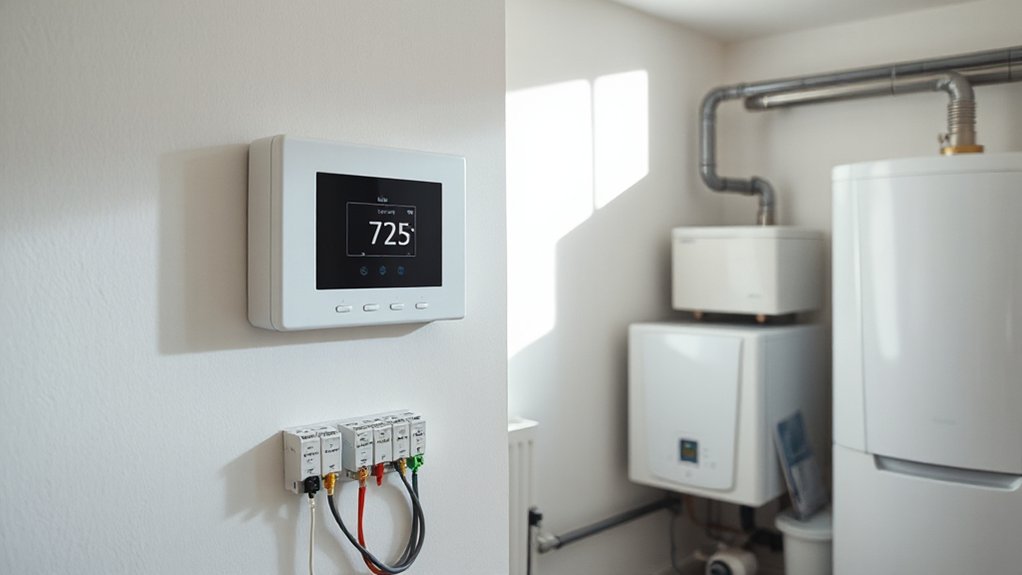
Before you install, confirm that your heating control system, power supply, and communication protocols are compatible across devices and existing wiring. This checklist ensures reliable operation and minimizes retrofit risks.
Verify device compatibility matrices from manufacturers, noting supported protocols (Zigbee, Z-Wave, Thread, Wi‑Fi) and max currents.
Map power requirements to the control board, transformer, and fuse ratings, avoiding overloads.
Assess wiring suitability, including common ground, relay coil isolation, and potential line interference.
Confirm software compatibility, app ecosystems, and firmware update paths.
Evaluate Smart thermostat aesthetics to ensure mounting, screen visibility, and enclosure fit within the space.
Plan for voice control integration, ensuring microphones, assistants, and wake words align with privacy and latency targets.
Document tested configurations, failover options, and future expansion paths.
User Tips for Easy, Efficient Control
To make smart heating controls practical, start with a clear, centralized setup that minimizes menu hopping and guesswork. You’ll gain faster responses, consistent comfort, and reduced energy waste by prioritizing a single, reliable hub and uniform scheduling logic.
Focus on a clean User interface that emphasizes stepwise adjustments and intuitive labels, so each family member can operate confidently. Consider Thermostat aesthetics that blend with your space while signaling status at a glance; a minimal, high-contrast display aids quick decisions.
Lock in preferred presets for different routines, and enable geofencing only if it genuinely improves efficiency. Regularly review usage data to fine-tune thresholds without overcomplicating the system.
- Streamlined control reduces stress and boosts satisfaction.
- Consistent visuals and labels prevent confusion in daily use.
- Clear feedback loops drive ongoing energy savings.
Troubleshooting Common Smart Heating Hiccups
When your smart heating system misbehaves, start with a quick, disciplined check of the basics: confirm power is on, the hub is connected, and the thermostat is communicating with the network.
If issues persist, diagnose with logs and error codes to isolate the fault. Look for pattern-based failures: intermittent connectivity, delayed responses, or temperature drift.
Common culprits include outdated firmware, mispaired devices, or calendar/schedule conflicts.
Address Smart thermostat errors by verifying network stability, reestablishing device pairing, and ensuring zone valves respond to commands.
Prioritize firmware updates from the manufacturer, and apply them promptly to resolve known bugs and security gaps.
If reset steps fail, document codes for support, then proceed with targeted replacements or professional diagnostics to restore reliable control.
Data-Driven Savings: AI, Analytics, and Advanced Opportunities
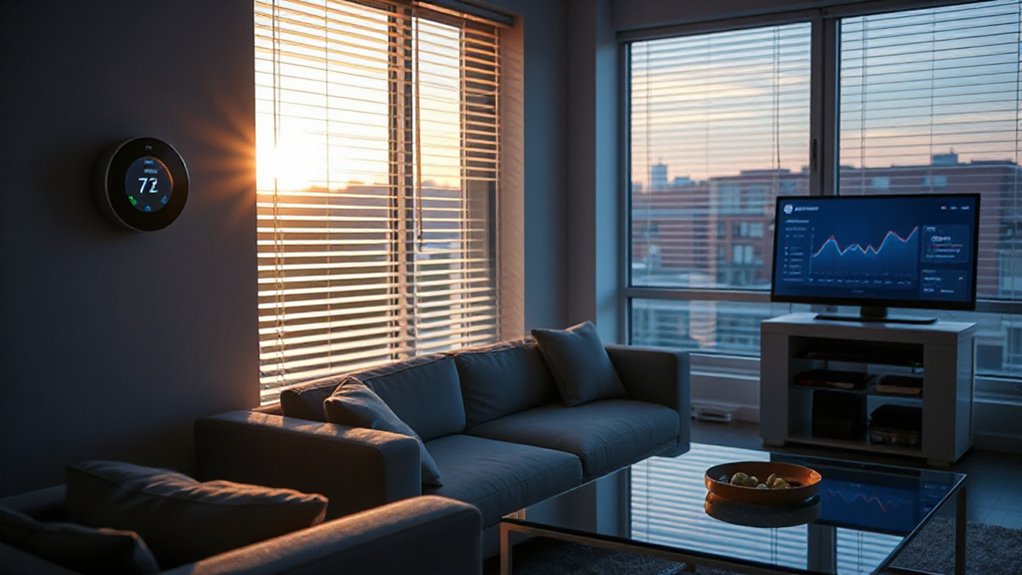
Data-driven savings hinge on AI, analytics, and advanced opportunities that translate usage patterns into actionable controls. You’ll leverage continuous data streams to optimize setpoints, detect inefficiencies, and automate adaptive schedules that align with occupancy and weather forecasts.
Through predictive maintenance, you’ll extend equipment life and prevent performance drops, while benchmarking against baseline consumption reveals where thermal insulation and ventilation systems can be enhanced for faster payback. This approach yields precise energy deltas without sacrificing comfort, providing auditable evidence for ROI and sustainability goals.
Embrace real-time anomaly detection to catch drift before it impacts costs, and use scenario modeling to stress-test strategies against seasonal variability. Your disciplined analytics program turns data into durable, measurable savings.
- Visualize impact with clear dashboards that motivate ongoing optimization
- Prioritize scalable upgrades, starting with insulation and airflow improvements
- Embed feedback loops that sustain efficiency through evolving usage patterns
Frequently Asked Questions
How Do Smart Heating Controls Affect Home Resale Value?
Smart heating controls can boost resale value modestly, especially if you emphasize smart home integration and energy savings. You’ll attract buyers who want efficiency, predictable costs, and seamless automation.
While price impact varies by market, features like remote control, learning schedules, and zoning help justify a premium. Make certain compatibility with existing systems, provide clear energy reports, and highlight maintenance ease.
In short, strong ROI comes from demonstrated energy savings and effective smart home integration.
Can Smart Thermostats Operate During Power Outages?
No, smart thermostats generally can’t operate during power outages unless you have backup power.
With on-site backup power, they stay functional, but otherwise they rely on the grid. You’ll lose smart control during outages unless you add a battery, generator, or UPS.
This reduces grid dependency only when backup power is available. If you want resilience, consider a system designed for outage compatibility and monitor battery levels to maintain critical HVAC control.
Do I Need Professional Installation for All Systems?
You don’t always need professional installation, but it depends on your system. For many smart thermostats, DIY installation works if you’re comfortable with wiring and following the manual.
However, compatibility concerns can trip you up with older boilers, multi-zone setups, or non-standard HVAC equipment. If you’re unsure, opt for professional setup to avoid errors, warranty issues, or unsafe wiring.
Always verify compatibility before you buy and check for required C-wire or power needs.
Are Privacy and Data Risks Addressed by These Devices?
Yes, privacy and data risks are addressed by these devices when you enable strong protections. Picture a locked thermostat, data streaming behind a shield.
Data encryption guards transmissions, preventing interception, while Privacy settings let you limit who taps in and what data is shared.
Keep firmware updated, disable unnecessary telemetry, and review access logs.
With careful configuration, you control exposure, and your heating system stays both responsive and secure.
How Often Do Firmware Updates Require Maintenance Downtime?
Firmware updates typically require occasional maintenance downtime, usually brief and scheduled during off-peak hours. Expect interruptions ranging from a few minutes to under an hour, depending on device type and network conditions.
You should plan for a short window once every few months, or when critical security fixes are released. Make certain backups and local control options are in place.
After updates, verify settings return to expected defaults and that sensors resume normal reporting.
Conclusion
You’ll appreciate how these controls blend sensing, learning, and remote fine-tuning for steady comfort and lower bills. Don’t worry about complexity—the right system adapts automatically, scales with your home, and plays nicely with renewables. Anticipated objection: “It’s too expensive.” In reality, you’ll recoup costs through energy savings and longer equipment life, while enhanced analytics guide smarter decisions. Ready to upgrade? A data-driven, ecosystem-ready solution keeps you comfortable and efficient today and tomorrow.