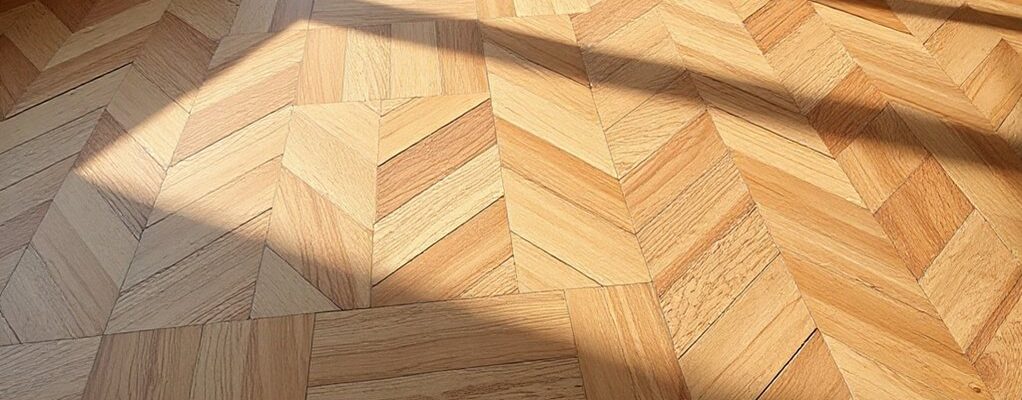
Like a well-placed lattice in a grand hall, parquet flooring sets the tone for space and light. You’ll explore how pattern, material, and finish interact to deliver durability and visual rhythm, from classic herringbone to modern tessellations. You’ll weigh species, subfloor prep, and maintenance steps, keeping a precise eye on cost and longevity. The outcomes matter, and the path to timeless, sustainable floors may hinge on the choices you make next.
What Is Parquet Flooring and Why Choose It?
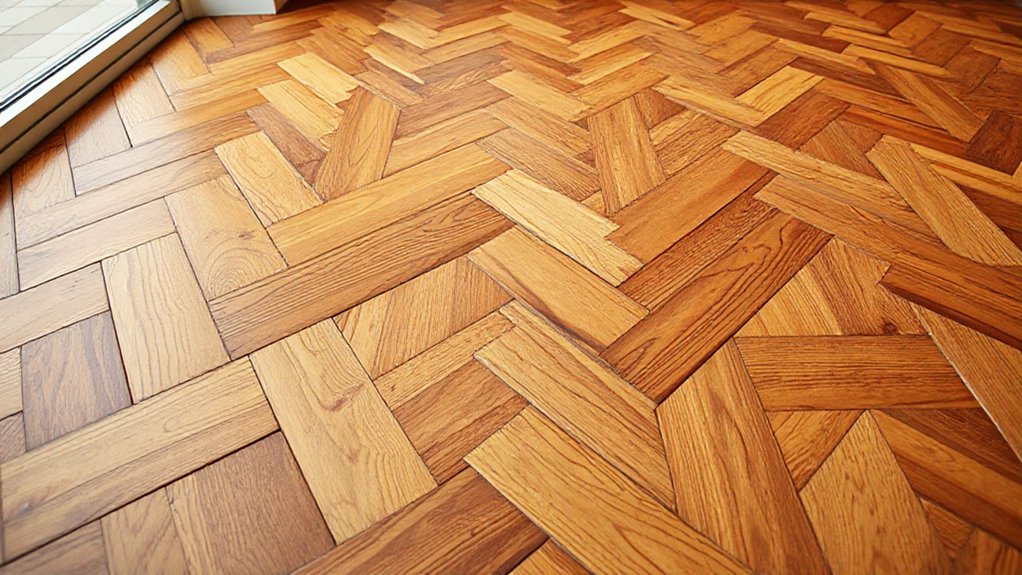
Parquet flooring consists of small wood blocks, typically arranged in geometric patterns, such as herringbone or basket weave, laminated into thin, uniform sheets. You’ll recognize parquet as a prefinished, modular system that reduces waste and enables precise layout control.
This flooring delivers stable dimensional performance due to engineered layers, while maintaining the visual depth of solid wood. Eco-friendly materials are often prioritized through responsibly sourced species and recycled content in backing layers, improving lifecycle impact without sacrificing strength.
When you select parquet, you gain long service life, low maintenance, and readily replaceable sections, supporting a sustainable approach.
DIY installation is feasible with careful subfloor preparation, alignment, and adhesive selection, provided you follow manufacturer guidelines and progress in measured, repeatable steps. Precision, not haste, yields ideal alignment and finish.
Parquet vs. Other Wood Floors: Key Differences
Parquet differs from other wood floors primarily in its modular construction and patterning; unlike solid planks, parquet uses small blocks arranged in geometric layouts that create distinct visual rhythms. You’ll notice precise tolerances, engineered layers, and standardized tongue-and-groove joins that enable consistent installation and performance.
Compared with traditional strip or plank flooring, parquet offers more predictable expansion, contraction, and stability under humidity shifts, thanks to its subdivision into discrete units. Eco-friendly materials may be incorporated through sustainable sources and responsibly manufactured substrates, which can reduce overall environmental impact.
Acoustic benefits arise from the fractal-like surface dispersion and the potential for underlayment optimization, improving sound transmission and absorption in occupied spaces. In short, parquet delivers controlled aesthetics, structural predictability, and relevant material advantages relative to other wood options.
How Parquet Patterns Evolved Over Time
You’ll trace how vintage grain patterns gave way to modern geometric styles, mapping the shift from hand-cut, irregular layouts to precise, machine-cut tessellations.
Contemporary designs optimize symmetry, repeatability, and material efficiency, enabling bold, repeatable patterns across floors and spaces.
This evolution sets the stage for inspecting how each pattern category—Vintage Grain Patterns and Modern Geometric Styles—impact installation, durability, and visual rhythm.
Vintage Grain Patterns
Early designs prioritized visual density, using single-direction runs that intensified grain textures and responded to hand-cut limitations. As tooling advanced, you gain the ability to replicate consistent angles and fractions, enabling interlocking motifs that resist warping while maintaining durability.
You evaluate species variation, ply layering, and finish tolerances, noting how vintage charm emerges from restrained contrast and measured repeatability. Recognize that pattern selection affected load paths, with tight kerf allowances reducing gaps and movement.
This knowledge informs your interpretation of archival pieces and guides careful restoration, preserving grain textures while honoring original intent.
Modern Geometric Styles
Geometric parquet patterns have evolved from simple, linear grids to intricate tessellations that optimize both aesthetics and structural performance. You explore how modern styles deploy interlocking motifs—hexagons, diamonds, and herringbones—arranged to maximize grain continuity and panel stability, while preserving interchangeability in installations.
Material choices, cut accuracy, and joint tolerances drive consistency across large areas, reducing gaps and minimizing movement. You’ll notice that advanced geometric schemes support precise alignment with room geometry, enabling repeatable patterns without visible seams.
Consider artistic murals integrated into floor layouts as functional accents rather than separate artwork, leveraging their visual impact without compromising load paths. Acoustic properties improve when pattern density and adhesive methods are optimized, balancing sound diffusion and footstep mitigation.
In practice, modern styles demand rigorous planning, calibration, and meticulous execution.
Popular Parquet Pattern Options Today
Parquet flooring today embraces a range of pattern options that balance classic appeal with modern practicality. You’ll encounter herringbone, chevron, and basket weave as core layouts, each delivering distinct rhythm and visual density.
Herringbone offers linear direction with robust stability, while chevron provides continuous zigzag symmetry for sharper interiors. Basket weave yields a textured, grid-like surface that emphasizes depth without overpowering space.
Diagonal and random patterns introduce subtle variation, enhancing dimmable lighting compatibility and perceived room size. Subtle border accents and insets refine progression between rooms and focal points.
When selecting, evaluate board size, groove system, and installation orientation to optimize structural performance and appearance.
Eco-friendly materials and acoustic benefits guide sustainable choice, ensuring long-term value while minimizing environmental impact.
Choosing Wood Species for Parquet
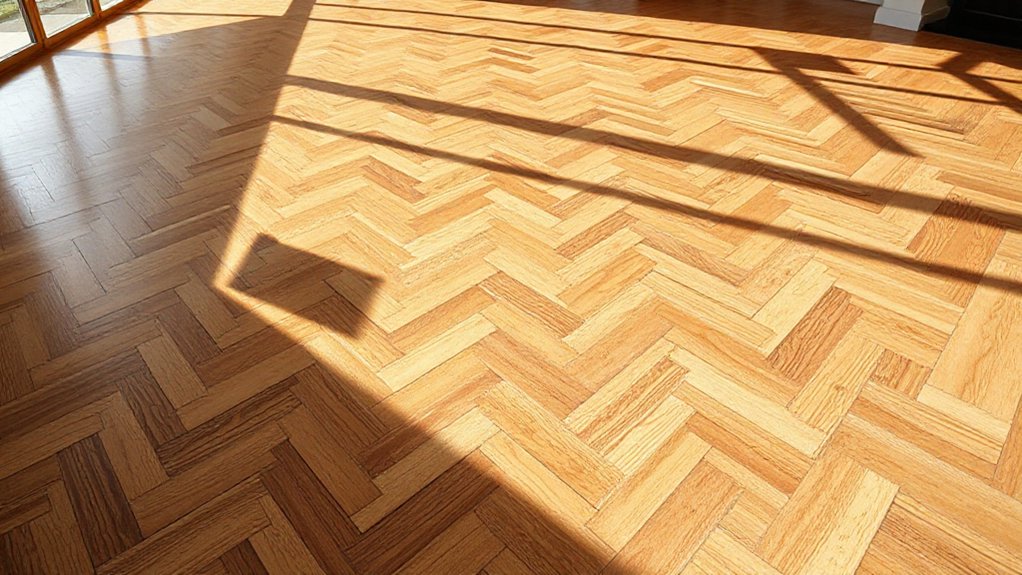
You must evaluate hardness, dimensional stability, and cutting characteristics to minimize panel gaps and vibration during installation. Consider wear resistance for high-traffic areas and seasonal expansion for climates with humidity swings.
Species with straight, uniform grain reduce misalignment risks and simplify pattern assembly, while stable adhesives support long-term integrity.
Prefer woods with predictable behavior under finishing and humidity shifts to maintain consistent color and joint fit.
Prioritize Eco friendly finishes to limit volatile compounds, and assure Sustainable sourcing to meet certification standards.
Document supplier provenance, testing data, and warranty terms to support reliable parquet performance over time.
Grain, Color, and Finish to Enhance Parquet
Grain patterns set the visual rhythm of a parquet layout, guiding how light interacts with each piece and influencing perceived floor depth.
Color choices range from natural, stained, to tinted finishes, with coatings that protect and enhance without obscuring grain.
Finish options, including matte, satin, and gloss, affect durability and glare while highlighting contrast between contrasting species or cuts.
Grain Patterns and Parquet
When selecting parquet, the grain pattern and color play pivotal roles in character, texture, and perceived depth. Matching these elements to room lighting and existing millwork guarantees a cohesive design.
You evaluate grain variation to predict visual rhythm across panels, ensuring alignment with joints and progressions. Choose patterns that support your space’s scale: tight, uniform grains for intimate rooms; pronounced grain for spacious areas.
Consider directional consistency to avoid jarring cross-grain appearances at doorways or focal walls. The color set should provide deliberate contrast or harmony with adjacent woods, influencing perceived warmth and formality.
Document grain orientation, plank width, and inset motifs to guide installation and future maintenance. Color contrast informs lighting response, while grain variation shapes texture perception, reinforcing the parquet’s architectural integrity.
Color and Finish Options
Color and finish selections define parquet’s perceived depth and tonal balance, guiding how grain, shade, and sheen interact under room lighting. You select color and finish to align with architectural context, traffic patterns, and maintenance plans.
Color trends influence compatibility with cabinetry, upholstery, and evolving styles, while uniformity across boards reduces visual interruptions in large areas. Grain precision dictates how texture reads under illumination, with denser grains yielding subtler contrast and more forgiving wear patterns.
Finish options span matte, satin, and low-sheen profiles, optimizing glare control and cleaning ease; clear coats preserve natural wood while tinted finishes introduce controlled warmth or contrast.
For durability, prioritize finishes with high hardness and appropriate abrasion resistance. Combine a climate-considerate stain with a compatible UVcure or oil-based sealer to maximize longevity. Finish options matter.
Subfloors and Underlayment for Longevity
Subfloors and underlayment are critical to the longevity of parquet flooring because a stable base prevents gaps, squeaks, and rapid wear. You must guarantee flatness, clean surfaces, and correct humidity before installation.
Inspect subfloors for structural integrity, cracks, or moisture damage; repair as needed to achieve a uniformly solid plane. Choose underlayment with appropriate moisture resistance and compressive strength to minimize telegraphing and movement.
Address level differentials with planned ramping or transition solutions, avoiding excessive height changes that stress parquet edges. For adhesive-based installations, verify compatibility between flooring adhesives and your underlayment system, and follow manufacturer protocols to prevent bond failures.
Subfloor preparation is mandatory: cure moisture, flatten high spots, and remove debris to guarantee full-face contact and long-term performance.
Installation Methods: Floating, Glue-Down, Nail-Down
Floating installation basics set the baseline for how parquet panels expand, contract, and interlock across the subfloor. The staggering and floating board gaps are controlled by a properly laid underlayment.
Glue-down vs. nail-down choices trade immediate stability and long-term strain on joints. You’ll compare adhesion strength, substrate compatibility, and installation speed in practical terms.
This discussion frames how these methods influence performance, precision, and future maintenance as you evaluate method suitability for your project.
Floating Installation Basics
What exactly defines a floating installation, and how do the three primary methods—floating, glue-down, and nail-down—differ in practice?
In a floating setup, planks interlock and rest atop a subfloor with a thin spacer, allowing for expansion and contraction without adhesive to the substrate. You’ll establish a uniform, continuous surface by locking rows and leaving expansion gaps at perimeter walls.
Eco friendly options include engineered cores and adhesives with low VOC content, though the floating method itself relies on the floating interface rather than full-subfloor bonding.
Acoustic properties improve when you install an underlayment designed for impact and sound reduction, while maintaining dimensional stability.
Precision cuts, proper acclimation, and consistent gaps prevent squeaks and buckling. Use manufacturer guidance to balance stability, performance, and ease of maintenance.
Glue-Down vs Nail-Down Pros
Glue-down and nail-down installations each offer distinct performance and schedule benefits. You’ll choose based on substrate, humidity control, and traffic expectations, not just cost.
Glue-down delivers superior dimensional stability on uneven subfloors and minimizes squeaks by eliminating nail reverberation. It also enables faster installation in large spaces with fewer fasteners.
Nail-down excels on wooden subfloors that provide inherent rigidity, offering easier spot repair and a robust feel underfoot.
For parquet, consider Eco friendly finishes to maintain a sustainable profile, and verify compatible adhesive systems or fasteners with your species.
Acoustic underlayment enhances sound transmission control under glue-down setups, especially in multi-story layouts.
In high-traffic areas, weight and subfloor conformity drive the decision; neither method should compromise expansion gaps or warranty terms.
Pattern Planning and Room Layout for Parquet
Pattern planning for parquet begins with a precise assessment of room dimensions, traffic patterns, and natural light to determine the most suitable layout. You translate architectural constraints into a feasible grid, selecting parquet patterns that maximize visual rhythm while minimizing waste.
Consider edge conditions, door swings, and sightlines to avoid awkward joints. Choose subfloor stability and expansion gaps consistent with climate and adhesive or fastener systems. Map your runs for continuity, aligning focal points with entrances or furniture anchors to enhance perceived space.
Color palettes influence perceived size and glow, so link grain direction to lighting. Document pattern repeats, rotation allowances, and trimming requirements for accurate installation.
Maintenance tips, including dust control and protective coatings, should be integrated into the planning phase to preserve color and rigidity.
Matching Parquet to Architectural Styles
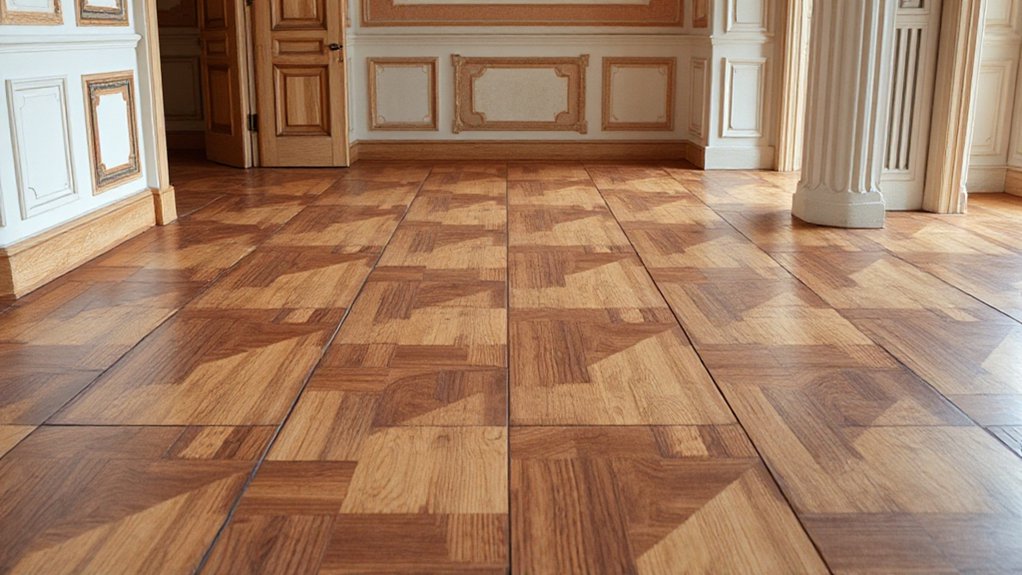
You should align parquet choices with the target architectural style by analyzing historical features, motifs, and period-specific detailing.
Consider how pattern, motif, finish, and grain coordinate with the space, ensuring consistency with proportional cues and material palettes.
This approach establishes a precise baseline for selecting patterns and finishes that reinforce the architectural narrative.
Historical Style Alignment
Parquet flooring should reflect the architectural language of the era it complements, guaranteeing pattern, grain, and finish align with historical context. You align board density, joint tolerances, and gloss level to period-appropriate cues, avoiding anachronistic contrasts.
Start with subfloor compatibility and humidity controls that preserve historic installations without introducing modern weaknesses. When selecting patterns, prioritize latticework, herringbone, or geometric arrays that historically informed room rhythm, corridor flow, and ceiling height perception.
Material choices should match era wood species and aging characteristics, while preserving structural integrity and long-term stability. Eco-friendly finishes are preferred, provided they meet durability and UV resistance requirements.
Acoustic insulation should be integrated where feasible, balancing authenticity with modern comfort. Document decisions to ensure reproducibility, maintenance, and scalable upgrades without compromising historical fidelity.
Pattern and Motif Matching
To align parquet with architectural styles, begin by mapping motifs to room vocabulary established by the era’s design language. You’ll select geometric or organic patterns that echo structural lines, column arrangements, and defining architectural features.
Evaluate scale relationships: a grand lobby calls for expansive, repeating blocks; intimate interiors benefit from tight, subtle motifs.
Maintain proportional fidelity by aligning parquet orientation with dominant sightlines and natural lighting cues.
Use contrast and color balance to reinforce period cues without overwhelming notable details.
Consider material provenance and factory-made options that reproduce historic tones with consistency.
Color enhancement should be planned to accent grain while preserving legibility of the pattern.
Environmental impact comes into play through lifecycle assessment, choosing responsibly sourced species, efficient installation, and low-emission finishes to sustain stylistic integrity.
Finish and Grain Coordination
How the finish and grain interact can make or break a parquet’s alignment with architectural styles. You assess finish choices first, then correlate grain orientation with period cues.
For modern interiors, opt for tight-grain sequences and matte or low-sheen coatings that emphasize linearity without glare. In traditional schemes, embrace pronounced grain patterns and warmer, amber-toned finishes to echo historic millwork, ensuring grain direction reinforces panel layouts and doorway lines.
Coordinate gloss levels with substrate tone; mid-level luster tends to harmonize diverse materials. Choose Eco friendly finishes to reduce environmental impact without sacrificing durability, and verify that textures don’t undermine legibility of patterns.
Prioritize Sustainable sourcing for wood species that complement the architectural context, and document finish batch compatibility to prevent tonal shifts across the installation.
Maintenance Essentials for Parquet Floors
Use pH-neutral cleaners and avoid wax buildup that can impede the wood’s breathability. Protect high-traffic zones with area rugs and felt pads on furniture legs to minimize abrasion.
Maintain stable humidity between 40–60% to reduce cupping and gaps; use humidification or dehumidification as needed. Schedule professional refinishing once surface wear becomes noticeable, aligning with manufacturer guidelines.
Consider Eco friendly options for cleaners and finishes when possible to reduce environmental impact. Be mindful of installation challenges in renovation contexts, ensuring acclimation and proper subfloor conditions before any maintenance regime.
Finishes and Sealants for Durability and Shine
Finishes and sealants are the core line of defense for parquet floors, delivering durability and a polished sheen without compromising wood breathability. You select finishes based on wear expectations, substrate type, and maintenance plans, ensuring film-forming properties align with traffic.
Apply polyurethane for robust abrasion resistance or penetrating oils for moisture balance and a natural look; both options preserve acoustic and tactile integrity when properly applied. Sealants create a barrier against moisture ingress and contaminants, reducing micro-splitting and wear patterns.
You must follow curing times, ventilation, and temperature guidelines to prevent tackiness or clouding. Cleaning tips emphasize gentle cleaners, frequent dusting, and avoidance of solvent-heavy products that can degrade film integrity.
Repair techniques focus on localized re-sanding and spot refinishing rather than full-coat renewal to minimize downtime and preserve color uniformity.
Common Parquet Problems and Fixes
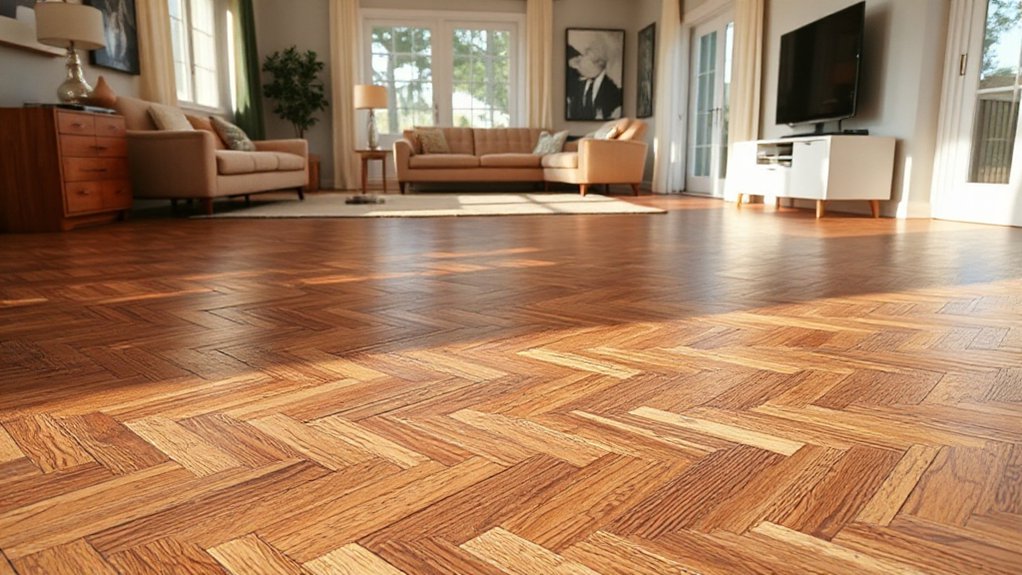
Common parquet problems often stem from moisture fluctuations, improper acclimation, or insufficient surface preparation, and addressing them quickly minimizes downtime and color mismatch. You’ll diagnose by inspecting cupping, crowning, gaps, and finish wear, then isolate sources before remedy.
For moisture-related issues, guarantee proper acclimation and control humidity; use dehumidification or humidification as needed and reseal high-use areas after correction.
Cleaning tips involve gentle dusting, damp-mopping with a wrung-out microfiber, and avoiding excessive water that can swell edges.
When repairs are necessary, apply targeted repair techniques: fill small gaps with matching filler, replace damaged boards, or shallowly sand localized wear and recoat.
Prevent recurrence by maintaining stable climate, protected entryways, and scheduled maintenance, documenting steps and outcomes for future reference.
Parquet Pricing: What Drives Cost
What drives parquet pricing, and how do you gauge its true cost? In this section, you examine material quality, species, and grade, since these foundations set base price. Engineered planks lower upfront costs but may affect long-term durability; solid parquet typically commands higher per-square-foot rates.
Pattern complexity and color contrast drive labor and waste, influencing both cutting precision and installation time. The finish type—oil, urethane, or prefinished—affects maintenance cycles and resale value, altering lifecycle costs.
Subfloor conditions, acclimation, and site preparation contribute to variability; tighter tolerances demand skilled installers and increase overhead. Volume discounts, warranty terms, and regional labor markets further shape final figures.
You’ll balance aesthetic goals with budget, projecting total cost via per-square-foot estimates, added by installation, materials, and contingency considerations.
Frequently Asked Questions
How Long Does Parquet Flooring Typically Last With Proper Care?
Parquet flooring typically lasts 20–30 years with proper care. Durability concerns arise from subfloor prep and wear patterns; maintenance tips include regular cleaning, humidity control, refinishing every 7–15 years, and prompt repairs to protect structural integrity.
Can Parquet Be Refinished Multiple Times Like Solid Wood?
Yes, you can refinish parquet multiple times, though less often than solid wood; plan for surface-level abrasions. With proper parquet maintenance, you’ll preserve gloss, and during parquet installation consider wear layers and refinish cycles for longevity.
Is Parquet Suitable for Bathrooms or Kitchens?
Parquet isn’t ideal for bathrooms due to bathroom moisture, which risks swelling and damage; in kitchens, it can offer decent durability if you choose water-resistant finishes and tight installations, but it remains more sensitive than solid or tile alternatives.
What Affects the Recycled or Reclaimed Parquet Availability?
Recycled or reclaimed parquet availability hinges on material sourcing and the recycling process. Like a careful surgeon, you map supply chains, verify provenance, and optimize processing to maximize yield while minimizing waste in the recycling process and material sourcing.
Do Parquet Floors Improve Indoor Air Quality or Emit VOCS?
Parquet floors can emit VOCs initially, affecting indoor air quality, but emissions decline over time as finishes cure. You should guarantee low-VOC adhesives and finishes to minimize VOC emissions and protect indoor air quality.
Conclusion
Parquet floors blend artistry with engineering, delivering timeless elegance and durable performance. By understanding patterns, species, finishes, and proper installation, you optimize aesthetics and longevity while minimizing maintenance. Precision in subfloor prep and sealing decisions directly affects wear, shine, and resilience. As you plan, weigh eco-friendly options and cost drivers to maximize value. Are you ready to select a pattern, species, and finish that align with your space’s function and your design vision?