Like a compass needle steady in a shifting market, Birmingham’s house prices sit near the national average, with gaps narrowing as demand and affordability align. You’ll see resilience in the face of volatility, driven by a diversified economy and improving infrastructure that attract both buyers and investors. Yet the city trails London and the south in price levels, so the key question becomes: where does value lie as regeneration and transport projects unfold? Let’s explore the data that shapes the answer.
Is Birmingham a Good Time to Buy or Invest?
You’ll see emerging resilience in mid-market segments, where rental yields and capital growth projections point to stable cash flow and upside from infrastructure upgrades.
Buyer confidence fluctuates with macro signals, but local indicators—sales velocity, days-on-market, and price dispersion—suggest selective opportunities rather than universal bargains.
If you’re evaluating timing, align entry with price stabilization and rising rents, while factoring financing costs and stress tests.
Birmingham Price Gap: How It Stacks Up Against the UK
You’ll see how Birmingham’s price gap compares with the UK, highlighting whether local values trail or outpace national averages.
Regional trends, versus national movements, show how Birmingham’s affordability and growth potential fit into broader market dynamics.
Key local drivers—supply, demand, and pricing momentum—frame the discussion on where Birmingham stands in the wider market trajectory.
Birmingham Price Gap Overview
Birmingham’s price gap versus the national average is narrowing, driven by rising regional demand and steady affordability advantages. You’ll see a tighter gap as prices soften in some regions while Birmingham sustains steady annual gains, constrained by a balanced supply pipeline.
Across the UK, price growth remains uneven, and Birmingham reflects a mixed trajectory: modest increases in established neighborhoods, alongside renewed interest in up-and-coming areas. Housing affordability improves when mortgage costs align with wages, supporting buyer activity without overheating.
The price disparity between Birmingham and the national average narrows as local demand strengthens and inventory stabilizes. In this overview, data point to a more resilient local market, characterized by steady price momentum and improving access for first-time buyers amid disciplined lending.
Regional vs National Trends
Regional trends shape how Birmingham’s price gap stacks up with the UK. You’ll see a clear regional disparity in price momentum, with Birmingham’s pace often lagging or catching up to national averages depending on sector activity and affordability constraints.
Over recent quarters, Birmingham’s year-on-year growth has trended with broader market stability, yet with sharper variance during housing supply shocks.
You’ll notice that regional performance drifts as demand concentration shifts between city cores and suburban corridors, influencing the gap versus the national median.
For buyers and sellers, this means timing matters: price resilience is evolving, but regional normalization is increasingly aligning with UK patterns.
In short, Birmingham mirrors the country’s volatility, while maintaining a modest premium in long-run value.
Local Market Drivers
You’ll see price timing align with local employment, student inflows, and redevelopment momentum, which fuels selective appreciation in established districts while peripheral areas lag.
Market stability hinges on rental demand and vacancy rates staying muted despite cyclical swings.
New build volumes influence pricing power, with planning approvals easing affordability constraints only if delivered at pace.
Property tax policy and incentives through regional programs can dampen or amplify movements, depending on absorption speed.
In short, Birmingham’s gap reflects a balance of affordability pressure, supply responsiveness, and concentrated demand that steadies or bends with macroeconomic signals.
Local Jobs and Wages: The Core of Birmingham’s Price Trends
Jobs and wages sit at the core of Birmingham’s price trends, shaping how affordable housing stacks up against the national picture. You’ll see local employment patterns imprint directly on asking prices and transaction velocity, with steadier job growth supporting sturdier price ceilings.
In recent quarters, wage growth has outpaced inflation, boosting buyer purchasing power and expanding demand for mid-market homes. When local employment tightens, competition among buyers intensifies, lifting price momentum even as mortgage costs rise.
Conversely, softer employment momentum tends to cool price appreciation, especially for entry-level segments. Pay attention to sector mix shifts, as tech and professional services rebounds can lift higher-value segments, while hospitality-led growth may temper overall trends.
Across Birmingham, data signals cautious but persistent upward pressure anchored by wage growth.
Infrastructure That Raises Value in Birmingham

Transport links, new housing, and upgraded utilities are the core levers shaping Birmingham’s value trajectory, with data showing quicker price responses near enhanced rail and bus networks.
You’ll notice market momentum where developments align with improved connectivity and reliable services, as housing supply expands alongside demand.
We’ll track how these infrastructure pillars correlate with price growth, density, and occupier quality scores to map future momentum.
Transport Links Boosting Value
Rail connectivity and ongoing investment are driving Birmingham’s value rise, as enhanced links shorten commute times and expand catchment for buyers and renters. You’ll notice market data showing faster journeys into the city center and stronger resale demand along new and upgraded corridors.
Year-over-year price momentum in areas with direct rail access remains above city averages, while tenancy demand grows in neighborhoods with improved transit nodes. Mortgage options are aligning with affordability bands, supporting higher buy-to-let activity in well-connected districts.
Housing affordability remains a key constraint for first-time buyers, yet lenders increasingly offer fixed-rate products and favorable stress-test terms near major stations. In short, transport-led housing turnover is stabilizing prices, with transport corridors acting as value accelerators rather than merely influencers.
New Housing Developments Impact
New housing developments are reshaping Birmingham’s value trajectory by expanding supply in high-demand areas and opening better infrastructure access. You’ll see lift in property values where new residential clusters pair with deliberate urban renewal, driving stronger buyer interest and faster absorption.
Data indicate tighter inventories in core zones, with completions shifting from isolated pockets to mixed-use districts, supporting price momentum over the medium term. Market signals show pre-sales and rental upside tied to transit-ready neighborhoods.
Developers increasingly prioritize walkable cores, green spaces, and school catchments to attract families. Environmental impact considerations are tracked through construction efficiency, energy performance, and local air-quality metrics, which influence investor confidence.
Upgraded Utilities Infrastructure
Are upgraded utilities driving Birmingham’s value acceleration, or is it the reliability and coverage you can count on? You’ll see utilities upgrades translating into measurable demand signals, with property listings emphasizing resilience and reduced downtime.
Data shows steadier occupancy rates and faster tenant turnover in areas with robust infrastructure development. Outages and congestion benchmarks have declined, supporting premium pricing bands and quicker permit approvals for new builds near upgraded grids.
Market forecasts reflect continued capital inflow into electrical, gas, and telecom upgrades, often linked to broader regeneration schemes. Buyers, lenders, and developers increasingly weigh proximity to upgraded utilities as a value differentiator, not just a convenience.
The trend suggests infrastructure development will remain a key price-tightening factor, reinforcing Birmingham’s appeal relative to national benchmarks.
Birmingham Housing Supply: What’s Available vs What’s Needed
Birmingham’s housing supply is tightening even as demand remains resilient, with new-build completions lagging behind growth in households and rental demand. You’ll see this reflected in a narrow supply-demand balance, where available units struggle to keep pace with ongoing population and job growth.
Data indicate higher vacancy churn in older stock but limited total new supply entering the market year over year. By quarter, construction starts show intermittent gains, yet completions lag behind population-led absorption, keeping prices supported but affordability stretched.
Rental markets tighten fastest, with rents rising as entry-ready stock remains scarce. In this environment, you’ll want to monitor planning approvals, land-bank utilization, and delivery timelines, as these factors directly influence Housing affordability and the broader supply demand balance across Birmingham.
Affordability in Birmingham: Incomes, Deposits, and Mortgage Limits
You’ll see how incomes are shaping Birmingham’s affordability alongside rising housing costs.
We’ll compare deposits and mortgage limits to the needs of typical buyers, highlighting gaps and shifting lender responses.
Early trends point to tighter qualification thresholds and faster adjustments in loan products as prices move.
Incomes and Housing Costs
Affordability in Birmingham hinges on income levels relative to typical deposits and mortgage limits, with the city’s housing costs outpacing wage growth in recent years. You’ll see housing affordability tighten as median earnings grow slowly while entry prices rise, shifting the local market toward smaller households and single buyers.
Data show income disparity persists between sectors, with higher-wage roles concentrated downtown and in professional services, while other sectors struggle to keep pace. Consequently, debt-to-income ratios hover near or above comfortable thresholds for many buyers, limiting options for first-time purchasers.
Rents also track price gains, amplifying monthly burdens even before mortgage service begins. If incomes fail to bridge the gap, overall demand softens only marginally, yet affordability remains the central market constraint for Birmingham’s housing outlook.
Deposits and Mortgage Limits
In Birmingham, deposits and mortgage limits are tightening the market despite rising prices: average deposits now represent a larger share of purchase prices, while loan-to-value ratios tighten for first-time buyers. You’ll see higher upfront cash requirements, pressing borrowers toward larger deposits or gifted equity to maintain access.
Mortgage eligibility criteria have grown stricter, with lenders prioritizing steady income, lower debt-to-income ratios, and stronger credit histories. This shift nudges demand toward seasoned buyers and investor activity, while first-time buyers confront tighter caps on loan sizes relative to value.
Deposit strategies become critical: consider phased or stepped deposits, gifts, or employer-assisted schemes to bridge gaps. Track regional lender guidance and national rate trends to calibrate borrowing limits for Birmingham’s evolving affordability landscape.
Birmingham Property Mix: Flats vs Houses – Price Implications
Despite market volatility, Birmingham’s property mix reveals clear price implications: flats typically command lower headline prices and build-to-rent demand engines, while houses carry higher long-term value and prestige premiums.
You’ll notice flats offer greater market liquidity amid shorter transaction cycles, yet suffer thinner capital appreciation compared with houses. In practice, price dispersion widens when considering location, amenities, and lease structures, with flats often correlating to lower maintenance costs but higher annual service charges.
Houses tend to outperform on value retention, driven by scarcity and perceived prestige, especially in leafy suburbs and riverside pockets. Property taxation considerations modulate these dynamics, influencing investor appetite, while market liquidity pressures keep price growth tethered to rental yields and macro conditions.
Demand in the Region: Students, Commuters, and Investors

You’ll see student demand rising as Birmingham’s universities expand intake and housing options, with occupancy rates tightening in key corridors.
Commuter connectivity continues to influence location choice, as faster rail links and bus networks shift demand toward well-connected suburbs.
Investor interest now leans toward rental yields in high-demand areas, guided by recent occupancy data, rent growth, and transaction activity.
Student Demand Trends
What’s driving demand in Birmingham’s rental market right now? Student demand remains a pivotal driver, with university intake patterns shaping occupancy across sectors. Data show higher first-year enrollments and growing postgraduate cohorts, lifting peak-season occupancy in Q3.
You’ll notice rents tightening in popular student enclaves, while newer purpose-built blocks absorb incremental demand faster than older stock. Commuter-friendly campuses sustain steady demand beyond term times, but local affordability pressures temper price growth for some groups.
Housing affordability now mediates purchase vs rental choices, keeping rental tenure attractive for students who value predictable costs and proximity to facilities. In market terms, you should watch enrollment rhythms, accommodation quality, and manager-led pricing strategies to capture share as supply cycles adjust.
Commuter Connectivity Impact
How does commuter connectivity shape demand in Birmingham’s rental market for students, commuters, and investors? You’ll see higher occupancy where transport links shorten travel times to universities, business hubs, and city centers.
Data shows sustained rent pressure near major rail stops and bus corridors, driven by predictable commutes and evening usage. Transportation infrastructure investments correlate with faster booking rates and stronger resale appeal, especially for shared accommodations and studio segments popular with students and professionals.
Market trends indicate that lines with frequent departures and reliable reliability boost tenant retention, reduce vacancy, and lift premium rents. Keep an eye on new park-and-ride schemes and integrated multimodal hubs, which broaden catchment areas and diversify demand.
Investor Interest Shifts
Investor interest in Birmingham is shifting toward higher demand from investors who prioritize speed-to-value and diversification. You’ll notice capital flowing into multi-tenant assets, student-focused blocks, and commuter-adjacent rentals, reflecting a region-wide tilt toward pragmatic, near-term returns.
Market data shows shorter hold periods and rising transaction velocity among small to mid-size portfolios, underscoring confidence in Birmingham’s rental cadence. Occupier demand remains robust in central corridors, while peripheral zones offer upside through redevelopment.
Trends point to selective pricing power for assets with proven occupancy history and stable yield. Market speculation remains tempered by macro volatility, yet granular indicators—yield spreads, occupancy, and renovation potential—signal disciplined investor decision-making.
Price Momentum in Birmingham: Recent Quarters and Yearly Trends
Price momentum in Birmingham has continued to show steady upward traction over the latest quarters, with prices rising faster than the national average in several consecutive periods.
In recent quarters, you’ll notice month-to-month data showing stronger gains in inner-city and regional hubs compared with outer boroughs, signaling a diversified appreciation pattern.
Yearly trends confirm a persistent uplift, though rate-of-change varies by submarket, highlighting price fluctuations rather than uniform spikes.
Market stability remains apparent as turnover improves and days-on-market shorten in several districts, supported by robust demand from first-time buyers and investors alike.
You can expect this momentum to persist into the near term, contingent on macro cues and local supply responses.
Continuous monitoring of quarterly velocity and annual swing will be critical for forecasting.
What Buyers Should Watch in Birmingham: Key Signals and Thresholds
Buyers should monitor signals that reveal where Birmingham markets are tightening or cooling could foretell ideal entry points. In practice, watch month‑over‑month price momentum, inventory changes, and days‑on‑market shifts to gauge momentum and timing.
Market fluctuations matter: a sustained slowdown in price growth often precedes more favorable negotiating terms, while rising listing activity can indicate increased seller caution. Track mortgage rate trends and lender appetite, as these influence buyer affordability and demand.
Pay attention to neighborhood‑level signals, such as cadence of price reductions and time to find a buyer, to identify pockets where thresholds for entry lower. Align these observations with your buyer priorities—budget ceilings, commute needs, and preferred property types—to sharpen decision points.
How Bidding Competition Shapes Birmingham Prices

What happens when bidding gets tight in Birmingham, and what does that mean for prices? When competition tightens, you see fewer bidding wars and longer listing times, gently softening price momentum.
Buyers gain leverage, push-back from sellers rises, and pricing strategies shift toward realism. In data terms, you’ll notice a cooling signal in days-on-market and a lower rate of price growth quarter over quarter.
Market saturation begins to influence offers, with properties often selling near, or slightly above, asking only in standout locations or with unique features.
For buyers, this environment creates more room for negotiation and contingencies. For sellers, it requires precise positioning and transparent valuation.
Rents vs Buy: Rent Resilience in Birmingham’s Gap Market
The Birmingham rent market has shown notable resilience even as buying activity fluctuates, creating a distinct gap between rental and purchase dynamics. In this gap market, you’ll see rental stability sustaining occupancy despite softer sales volumes and price pauses.
Data indicate steady year-on-year rent growth in core Birmingham boroughs, with demand concentrated around affordable clusters and commuter nodes. Vacancy rates remain low, while renewal rates outpace new leases, signaling persistent tenant loyalty and limited supply response.
Market resilience appears driven by rental affordability relative to higher mortgage entry costs and tighter lending standards, which keep demand anchored. Expect gradual rent normalization rather than sharp deceleration, as buyers calibrate budgets while renters capitalize on long-term value and structural housing constraints.
Rental stability reinforces Birmingham’s divergence between rent and buy trajectories.
Local Policy Impacts on Birmingham’s Planning and Development
Local policy shifts are shaping Birmingham’s planning and development trajectory, with zoning updates, affordable housing mandates, and streamlining reforms directly influencing project timelines, site viability, and investor confidence.
Data shows tighter zoning policies are reallocating density targets, accelerating mixed-use trials, and prioritizing transit-oriented development across key corridors. You’ll see land use decisions increasingly tie to infrastructure commitments, affecting parcel values and financing conditions.
Market trends indicate compliance costs are rising, yet predictability improves with standardized permit processes and clearer timelines. Developers report tighter feasibility margins but faster approvals for shovel-ready sites, especially where councils align affordable housing quotas with grant programs.
As you monitor permits, track policy-linked subsidies and sector concentration shifts to anticipate supply responses and price momentum in Birmingham’s evolving growth ecology. Zoning policies, Land use.
Area Hotspots in Birmingham: Where Prices Are Differing Most
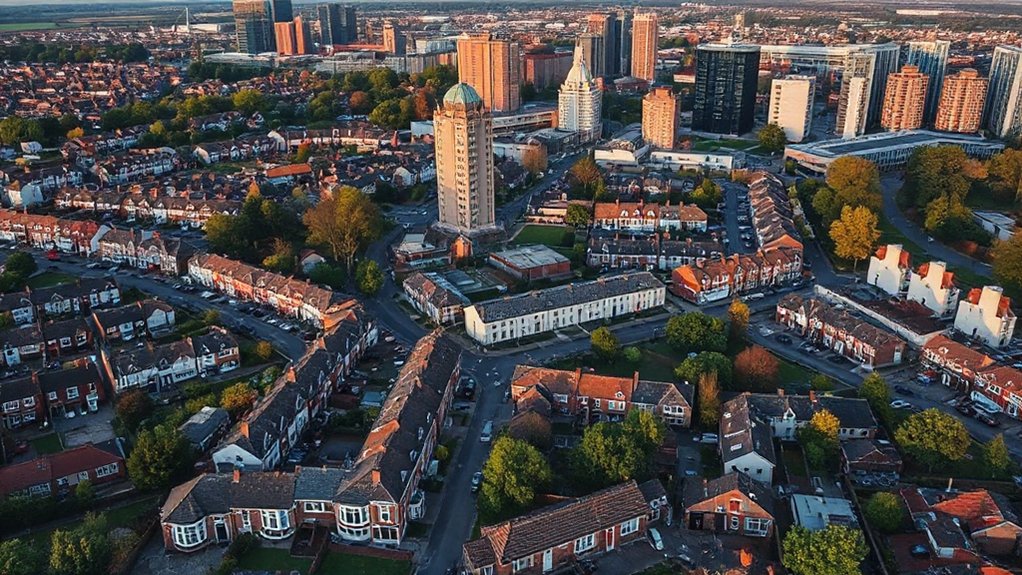
You’ll notice clear hotspot price gaps across Birmingham, with certain neighborhoods pulling away from the city average. The variance highlights tell a tight story of where buyers and investors are prioritizing value and growth potential.
We’ll unpack these neighborhood differences, focusing on the hotspots and what the gaps imply for timing and strategy.
Hotspot Price Gaps
Where are Birmingham’s price gaps widest, and what do they reveal about demand hotspots? You’ll see sharper divergences between city fringe areas and established core districts, signaling where buyers perceive value under shifting market conditions.
Data shows core neighborhoods sustaining higher median prices, while outlying zones lag yet exhibit rising momentum in some corridors, creating measurable price gaps. These gaps track demand hotspots driven by accessibility, schools, and amenity access, even as overall market fluctuations compress or inflate premiums seasonally.
Price elasticity varies by area, meaning small changes in demand can produce outsized price moves in hotter pockets or slower responses in steadier districts. Interpreting gaps helps you gauge where buyers and investors are most active, and where price pressure is likely to intensify next.
Neighborhood Variance Highlights
Birmingham’s price landscape shows clear variance across neighborhoods, with distinct hotspots where demand concentrates and prices outpace the city average. You’ll see some clusters near developing corridors and riverside pockets where apartment rents and sale prices rise faster than the regional norm.
This neighborhood variance highlights how buyer intent shifts with accessibility, school quality, and transit links. In practice, you’ll notice higher premiums where local amenities cluster—cafés, parks, and culture hubs—driving both demand and resale value.
Market signals point to continued divergence as upgrades and redevelopment projects attract new residents. If you map price growth by district, you’ll capture the tempo of demand in real time, clarifying opportunities for investors and families steering through neighborhood diversity and evolving service offerings.
Birmingham’s Economic Fundamentals: Jobs, Wages, and Growth Outlook
Birmingham is anchored by a diversified economy with steady job creation, rising wages, and a clear growth trajectory ahead. You’ll see Economic stability underpin near-term activity, with services and professional sectors driving hiring alongside resilient manufacturing.
Employment growth remains above national averages in key zones, supported by skill upgrades and targeted local incentives. Wage inflation tracks modest, sustainable gains, helping household budgets without overheating local demand.
Data signals stronger productivity in tech-adjacent roles and logistics, aided by regional distribution networks and business services clusters. Market momentum is underscored by expanding employment pipelines and capital investment in urban centers.
While external headwinds exist, the baseline outlook remains constructive, with consistent job opportunities and income growth reinforcing Birmingham’s appeal to firms and workers alike.
Infrastructure Bets for Birmingham: HS2, Transport, Regeneration
HS2, local transport upgrades, and regeneration projects are shaping a multi-speed infrastructure agenda that could shift Birmingham’s growth trajectory. You’ll see project pipelines converging on station hubs, with HS2 enabling faster links to London and the Midlands, compressing commute times and expanding catchment for urban revitalization.
Transport upgrades—bus lane expansions, tram extensions, and cycle networks—are delivering congestion relief and higher modal share, supporting a more accessible urban core.
Regeneration initiatives around key quarter sites are catalyzing private investment and mixed-use development, boosting property demand in premium pockets.
Market signals show steady capex alignment with local employment growth, yet execution risk and planning cadence remain pivotal for returns.
Cultural heritage assets are leveraged to attract tourism-anchored demand, reinforcing Birmingham’s distinct value proposition.
Birmingham in the National Backdrop: Positioning Within UK Trends
Across the UK, Birmingham sits at a pivotal juncture where local momentum meets national trends. You’ll see a city whose price trajectory mirrors broader regional patterns, yet with distinct deviations driven by sector mix and scale.
Data show steady affordability compared with southern markets, while house price growth tracks alongside northern and Midlands hubs when you adjust for size and supply. Population aging, demand from students and professionals, and steady rental yields push Birmingham’s market into a stabilizing phase amid national volatility.
Cultural heritage anchors visitor demand and premium activity, while expanding Green spaces support quality of life metrics that markets reward. In this national backdrop, Birmingham’s position blends resilience with opportunity, signaling measured ascent within UK housing dynamics.
Investment Scenarios: When Birmingham Outperforms or Underperforms
When Birmingham outperforms, investors typically benefit from a tilt toward faster rent growth and higher occupancy in mixed-use and regeneration zones. These areas are driven by sector clusters in tech, logistics, and creative industries that attract higher-yield tenants.
In these periods, you’ll see revenue resilience as demand concentrates around revamped corridors and employment hubs, supported by improving transport links and amenity ecosystems.
Historical fluctuations show cyclical bursts tied to development cycles and policy incentives, so you should align exposure with project pipelines and lease structures that capture upside in turnover and re-leasing.
Market predictions suggest continued volatility near cycle tops but sustained gains where diversification across zones mitigates risk.
Track occupancy, rent indices, and capex timing to calibrate entry, scaling, and exit strategies for different Birmingham submarkets.
What This Means for Buyers Now: Practical Takeaways for Decision-Makers
For buyers right now, focus on what the data says about Birmingham’s price trajectory, rental demand, and regional growth momentum to inform timing and strategy.
Prices show tempered growth with selective pockets of strength, suggesting selective entry could mitigate downside while capturing upside in high-demand areas.
Rental demand remains resilient, supporting yields even as mortgage costs influence affordability.
Regional momentum points to continued demand from both buy-to-let investors and owner-occupiers, underscoring demand stability across mid-tier neighborhoods.
Market stability appears improving, but cycles vary by micro-area and property type.
Buyer motivations—cash-flow priority, long-term equity, and risk tolerance—should guide portfolio mix and risk budgeting.
Align decisions with evolving fundamentals, monitor pricing signals, and target assets that balance income with potential capital appreciation.
Frequently Asked Questions
How Do Mortgage Rates Affect Birmingham Specifically?
Mortgage rates affect Birmingham specifically by shifting affordability and demand; you’ll feel mortgage fluctuations in approval rates and monthly payments, while lending criteria tighten or loosen, influencing who borrows and which properties remain competitive in a trends-driven market.
Which Neighborhoods Show the Steepest Price Drops?
Like a weather vane, you’ll notice the steepest price drops in inner-city and peripheral neighborhoods. You’ll see neighborhood decline and price fluctuation cluster around high supply, slower demand, and recent economic shifts driving sharper declines in specific districts.
Do School Quality or Universities Drive Prices More?
School reputation and university proximity both influence prices, but school quality tends to drive larger, steadier gains; you’ll see sharper bumps around top-rated districts, while close university access sustains demand even amid broader market shifts.
How Do Council Taxes Influence Affordability Locally?
Ironically, council taxes don’t just tax; they shape your budget. You’ll feel property tax effects on Local affordability, as rising charges push true costs up, even as house prices wobble. You hear trends, you adjust your strategy.
What Are Seasonal Price Patterns in Birmingham?
Seasonal price patterns in Birmingham show modest spring upticks and autumn cooldowns, with winter dips and summer bumps driven by demand swings. You’ll note seasonal fluctuations, holiday impact, and year-over-year trends guiding your market assessments.
Conclusion
Birmingham sits between affordability and aspiration, a city where steady growth meets selective momentum. As national prices spike, its gap narrows yet stubbornly persists, pairing modest upside with lower entry costs. Jobs and wages anchor resilience, while infrastructure bets promise future lift. You’ll see steady, not spectacular, appreciation—unless regeneration accelerates the upside. The choice isn’t “buy or wait,” but “buy with awareness”—target areas, time your entry, and ride the midlands’ measured ascent.