
Top-rated laser levels for home improvement balance accuracy, durability, and value across line, dot, and rotary types. Look for 1–2 mm precision per 10 m indoors, solid IP-rated housings, and stable auto-leveling for quick setup. Consider beam visibility, range under typical lighting, and battery life with reliable spares. Accessory ecosystems—mag mounts, tripods, and detachers—boost workflow. With rugged construction and proven calibration procedures, these tools keep projects on track; more details await as you explore further.
Key Takeaways
- Prioritize accuracy (1–2 mm per 10 m) and fast auto-leveling for reliable interior alignment.
- Choose the laser type by task: line lasers for rooms, rotary lasers for large spaces, dot lasers for references.
- Check durability: IP rating, rugged housings, and shock resistance for job-site use.
- Ensure versatile mounting and power options: magnetic mounts, tripods, spare batteries, and USB-C charging.
- Favor brands with solid support, documented calibration procedures, and accessible accessories.
What to Buy First: Laser Level Buying Criteria for DIYers
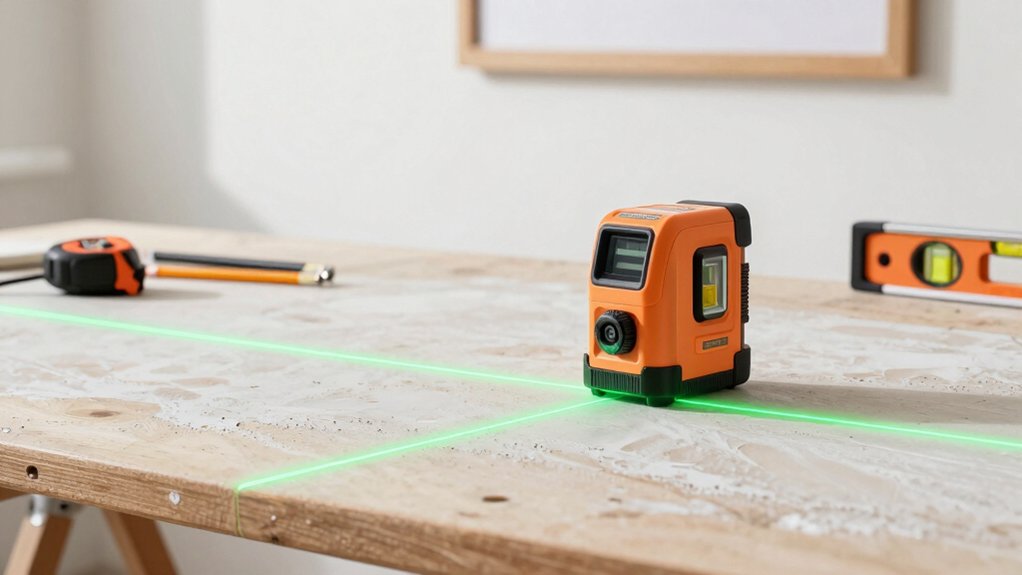
When you’re choosing a laser level for DIY projects, start with core criteria that affect accuracy, reliability, and value. You measure performance by grade, TTL, and self-leveling speed, then compare build quality and IP rating for durability.
Prioritize projected line visibility, beam width, and runtime under typical workspace conditions to forecast real-world results.
Assess laser level accessories that extend capability—tripods, pendants, and mounting plates increase setup precision, while detectors reduce errors in bright environments.
Consider laser level brands with proven field performance, strong warranties, and responsive support.
Price should reflect specifications, not hype; demand repeatable results per project type.
Finally, verify compatibility with your kit and future upgrades, ensuring scalable performance as demands grow.
Line, Rotary, or Dot: How to Choose the Right Laser Type for Your Space
Line lasers, rotary lasers, and dot lasers each serve different alignment tasks and workspaces. You choose by considering line continuity, rotational reach, and target size, matching tool to task for maximum laser alignment and measurement precision.
In tight interiors, line lasers deliver steady plumb and level lines. For large rooms, rotary lasers provide 360-degree elevation and fast transfer across zones. Dot lasers excel when you need remote reference points without continuous lines.
Evaluate visibility, range, and battery life across environments. Consider mounting options and durability if dust, debris, or moisture are factors. Your decision should balance task scope, required precision, and workflow speed.
- Line laser use cases
- Rotary laser performance
- Dot laser targeting
- Mounting and durability considerations
Quick Setup: Set Up and Calibrate in Minutes
Setting up and calibrating a laser level is a quick, repeatable process that keeps your measurements accurate across line, rotary, and dot models. You’ll power up, mount, and level using built-in auto-level or a precise manual bubble reference, then confirm alignment with a targeted test plane.
In minutes, you’ll lock vertical and horizontal references, verify beam consistency, and record offsets for repeatable projects. Prioritize laser safety by donning eye protection and verifying beam paths before operation.
Color visibility is vital: choose high-contrast indicators and ensure room lighting doesn’t wash out the line. Document calibration results, note environmental drift, and recheck after impacts.
With disciplined setup, you gain reliable, repeatable accuracy, eliminating guesswork and delivering rail‑straight results across tasks.
Budget Picks: Best Budget Laser Levels for Small Projects
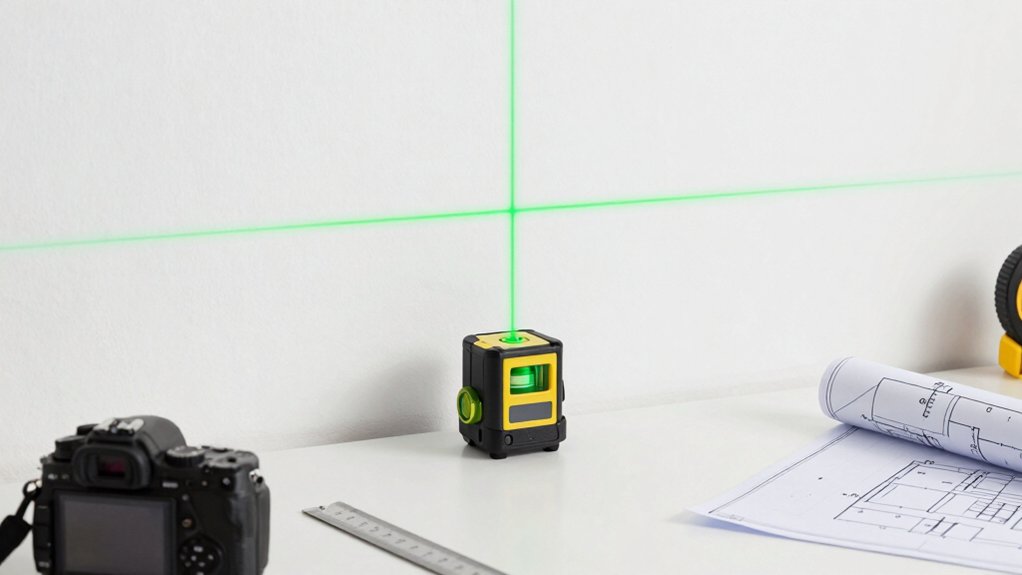
Budget picks for laser levels focus on dependable accuracy without breaking the bank. You’ll select compact models that deliver solid lines, simple setup, and reliable battery life for small tasks. Look for laser level brands that emphasize repeatable performance, durable housings, and clear visibility in various lighting.
Ergonomic design matters: grip comfort, single-button operation, and slim profiles minimize hand fatigue during longer projects. You gain control over horizontal or vertical reference lines without overspend, enabling precise layout work from shelves to tiling.
- Compact chassis with clear, bright lines
- Easy one-handed alignment and quick calibration
- Long-lasting batteries and fast recharge
- Durable construction suited for small, frequent jobs
Mid-Range Options: Top Mid-Range Lasers for Consistent Accuracy
You’ll evaluate mid-range lasers by consistency of accuracy, focusing on calibration stability and repeatable measurements across a full room. Look at performance metrics like error tolerance per 10 m, pendulum swing consistency, and how thermal drift affects vertical/horizontal alignment.
We’ll compare features that support steady results—lock-in modes, self-leveling speed, and visible beam clarity—to help you choose a dependable mid-range option.
Consistent Accuracy Essentials
Mid-range laser levels balance accuracy with practical features, delivering consistent alignment results across typical home improvement tasks. You’ll prioritize repeatable readings, stable plumb and level lines, and dependable compensation for offset surfaces.
Calibration habits matter: laser level calibration should occur before precision work, with checks on tripod stability and suspension angle. In practice, you’ll rely on a robust v-meter or self-leveling function to minimize drift, while preserving quick setup for fast projects.
Below, a concise picture of essential capabilities:
- Self-leveling consistency and lockable modes for stubborn angles
- Bright, narrow beam with controlled fan for long-distance accuracy
- Durable housings and IP ratings for shop environments
- Clear indicators and documented laser safety guidelines
Mid-Range Performance Metrics
Top mid-range laser levels deliver reliable performance without tapping out on features or price, prioritizing repeatable readings and stable line quality across common job-site conditions.
In this segment, you evaluate metrics that matter: slope-free accuracy, beam visibility in ambient light, and consistent self-leveling speed under load. Expect repeatable 90-degree reference checks within ±0.25 degrees, plus cross-line stabilization that maintains visibility from 5 to 20 feet.
Battery life, rugged enclosure, and dust/seal ratings influence uptime, so quantify runtime under typical workloads. Prioritize calibration workflows that minimize drift; plan laser level calibration intervals aligned with usage intensity.
Always observe laser safety practices, verifying eye-safe classifications and proper protection for all operators. Precision-driven choices reduce rework and strengthen overall project integrity.
Pro-Grade Picks: Durable, High-Precision Lasers for Heavy Renovations
For heavy renovations, pro-grade laser levels deliver unmatched durability and precision, combining rugged housings with high-impact resins and IP-rated protection to withstand job-site dust, moisture, and drops.
You’ll quantify performance with real-world metrics, not hype, prioritizing repeatable alignments and rapid setup. Emphasize laser level calibration to maintain accuracy across deltas, and follow laser safety guidelines to protect crew.
- Reinforced chassis and sealed optics reduce drift under heavy vibration
- High-contrast, multi-axis beams for wire-tight layouts in challenging spaces
- Immediate diagnostic indicators track calibration status and battery health
- Robust, tool-free adjustments enable on-the-fly corrections without slowing work
Trust data-driven results, not anonymous claims, to deliver power, precision, and reliability when renovations demand peak performance.
Core Features You’ll Actually Use: Accuracy, Range, Visibility, and Battery Life
When you pick a laser level, you’ll prioritize four core metrics: accuracy, range, visibility, and battery life. You’ll measure accuracy in order to minimize rework, demanding sub-1/16 inch at typical wall heights and consistent variance across out‑to‑a‑couple‑hundred feet.
Range matters for large rooms and exterior projects, so you’ll compare how well a unit maintains line integrity at distance and on uneven surfaces. Visibility is nonnegotiable: you’ll favor bright, outdoor-rated emitters and pulsating modes that adapt to ambient light.
Battery life translates to real productivity, so you’ll scrutinize runtimes under continuous use and standby. Prioritize laser level calibration procedures and solid safety features; balance performance with laser safety to avoid drift, downtime, and hazards.
Mounting Options: Mounts and Surfaces That Work Best
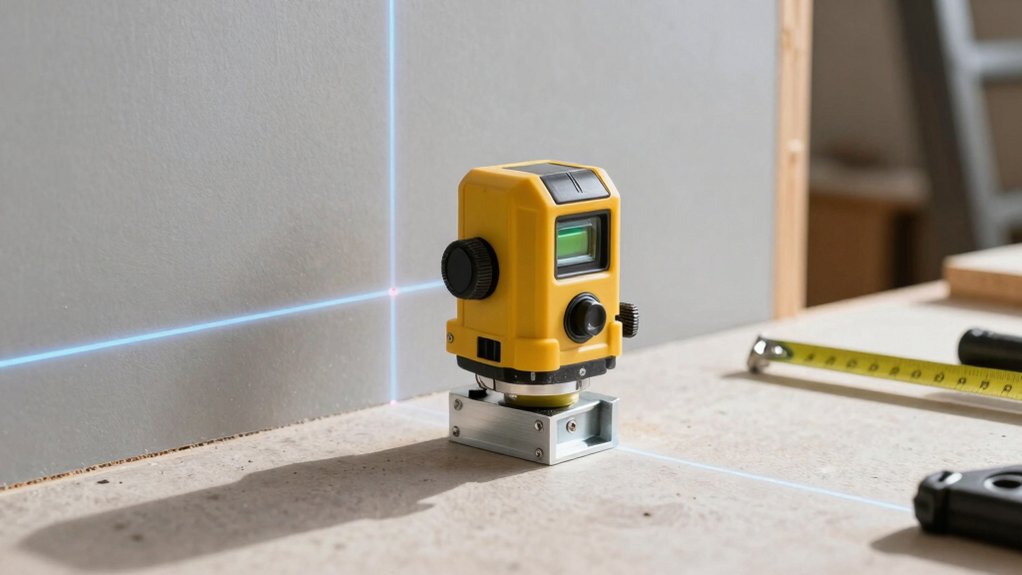
Mounting options determine how reliably your laser line stays true over time and across surfaces. You’ll evaluate mounting stability and surface compatibility to minimize drift and misalignment because precision hinges on secure attachment. Choose interfaces that resist vibration, temperature shifts, and accidental bumps, maintaining consistent reference points.
Below, practical options illustrate reliability across common materials:
- Magnetic mounts for ferrous metals, quick positioning with minimal surfaces prep
- Bracket suspensions and wall-anchors on drywall or concrete, tuned for load and stability
- Tripod-based systems on uneven floors, with center-pivot leveling for true plumb
- Clamp adapters compatible with glass, tile, or wood, reducing surface damage while preserving line integrity
These choices optimize durability, simplifying calibration and ensuring repeatable results in varying work environments.
Project Scenarios: Shelving, Tiling, and Molding Workflows
Shelving, tiling, and molding workflows demand precise, repeatable reference lines; alignments must hold steady across material changes and task sequences to avoid rework. You’ll rely on wall alignment to establish true plumb and level axes before fasteners or adhesives.
For shelving, you map anchors to a consistent vertical plane, then verify with cross checks at each corner.
Tiling requires parallel reference lines to govern grout lines, ensuring consistent tile heights as you progress.
Molding workflows hinge on base and crown lines that survive substrate variation and paint preparation steps. Maintain calibration during material swaps, documenting any deviation.
Use laser references to minimize rework, and confirm paint preparation surfaces remain free of dust and oil before finishing.
Precision yields predictable results and steady workflow momentum.
Performance Basics: What to Expect for Accuracy, Range, and Durability
You’ll want to start with the core metrics: accuracy benchmarks, range capabilities, and durability factors, and how they translate to real-world layouts.
Expect tight tolerance values, specified operating ranges, and lifecycle considerations that affect long-term performance.
This discussion should quantify what you can rely on across tasks like alignment, transfer, and repeated setups.
Accuracy Benchmarks
When evaluating accuracy benchmarks, expect a laser level to maintain a vertical and horizontal alignment within a tight tolerance over its specified range. In practice, most consumer models deliver 1–2 mm deviation per 10 meters and maintain that accuracy across typical indoor distances.
- Clear, verifiable tolerances show real-world performance versus spec sheets
- Consistent cross-line and point alignment under load and random vibrations
- Minimal drift when swapping batteries or toggling modes
- Documented reproducibility across benchmarks, not marketing hype
You’ll want laser level myths debunked and brand comparisons weighed against test data, not promises. Precision matters; choose models with traceable calibrations and measurable error budgets to back every projection line.
This focus ensures dependable layouts, fewer re-dos, and peak project performance.
Range Capabilities
Range is the practical frontier of a laser level’s performance, so expect measurements to align with stated ranges while accounting for real-world conditions.
In this section, you’ll quantify how far you can project a level line and how spacing holds across rooms. Expect variance by surface texture, ambient light, and device alignment.
For accurate results, verify the device’s rated range under typical working distances, then anticipate a margin of error within manufacturer specs.
Precision users prioritize consistent repeatability, so you’ll rely on periodic laser calibration to sustain accuracy across sessions.
Remember laser safety practices; keep beams away from eyes and follow enclosure guidelines.
Range reliability hinges on calibration discipline and proper setup, not just peak specifications.
Durability Factors
Durability matters as much as accuracy and range, because rugged conditions expose laser levels to drops, vibration, and dusty work environments. You’ll gauge performance by material durability, weather resistance, and the seal integrity that keeps internals safe during site shifts and sudden storms.
Expect ingress protection ratings and rugged housings that resist impact, dust, and moisture without drift. Real-world tests show drop tests, temperature cycling, and vibration simulations predicting long‑term accuracy under load.
Prioritize units with reinforced bezels, gasketed panels, and lens shields that preserve alignment. Short of calibration, durability is the differentiator you need for enduring precision.
- material durability indicators (mil-spec or IP ratings) and tested shock absorption
- weather resistance under heat, cold, humidity, and dust exposure
- sealed optics and reinforced housings for long-term alignment
- maintenance cadence that preserves straightness and lock integrity
Power and Care: Battery Life, Power Options, and Maintenance
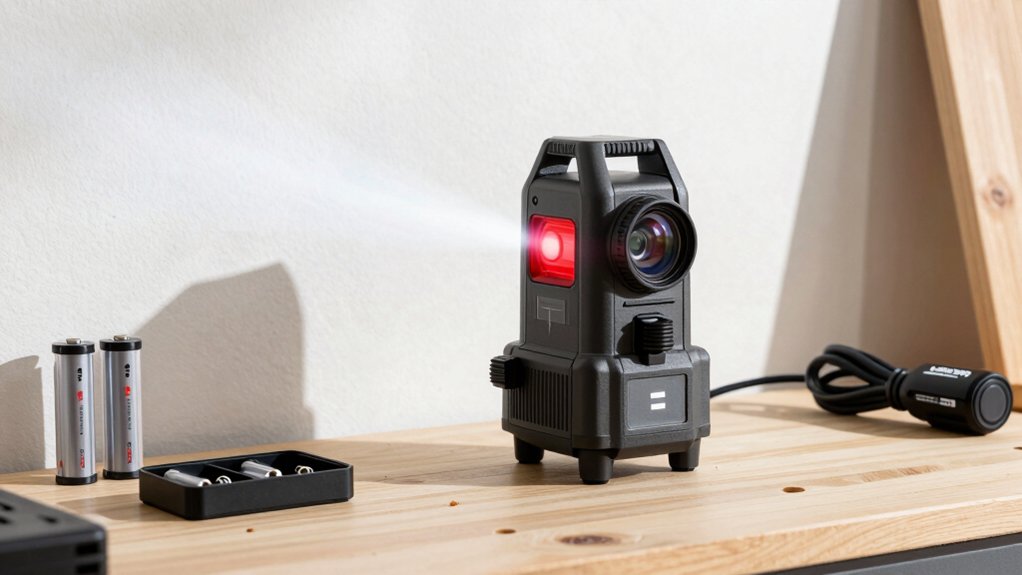
Power efficiency is essential for uninterrupted work, so understanding battery life, power options, and maintenance helps you maximize every tool session. You’ll prioritize models with high battery longevity, measured in hours of continuous operation at typical lighting and tilt ranges, to minimize downtime.
Compare recharge times, spare-cell availability, and USB-C passthrough for rapid swaps between tasks. Power options differ: built-in Li-ion packs, replaceable cells, or durable rechargeable packs; assess nominal voltage, capacity, and discharge rate for your typical job duration.
Implement clear maintenance routines: keep contacts clean, calibrate periodically, and store at recommended temperatures to preserve capacity. Track cycle counts and voltage sag under load, and document your findings for future purchases.
This disciplined approach sustains peak performance and predictable results.
Smart Upgrades: Useful Accessories to Boost Your Workflow
Smart upgrades can shave minutes off setup and maximize accuracy, building on your attention to battery life and maintenance by adding targeted accessories that fit your workflow. You’ll choose laser level accessories that tighten tolerances, reduce repositioning, and improve repeatability, delivering measurable gains in workflow enhancements.
- Magnetic mounting plate for rapid, repeatable alignment
- Detail-grade brackets and prisms for precise transfer of lines
- Tripod collars and clamps to eliminate wobble under load
- Bluetooth or RF remote for hands-free kickoff and verification
These components quantify impact: faster boot, tighter calibration, and consistent line height. Each accessory integrates without clutter, scaling your system’s precision. You gain verifiable data on setup time reductions and accuracy improvements, empowering decisions and speeding project milestones with confidence.
Troubleshooting at a Glance: Quick Fixes for Common Issues
When a laser level misbehaves, you can quickly isolate the issue with a targeted, data-driven checklist. You assess laser alignment first, confirming the unit is level and calibrated, then verify the pendulum lock status and battery condition.
Next, test beam visibility by switching modes and inspecting for diffused or dim output, noting any anomalies. If the beam is faint, adjust the output knob or inspect optics for dirt and smudges; clean accordingly with manufacturer-approved tools.
Recheck mounting stability, as vibration or tilt undermines accuracy. If the line shifts unexpectedly, recalibrate, then reverify against a known reference.
Document findings with timestamps and distances to build a corrective path. Resolve issues methodically to preserve laser alignment and beam visibility for precise, repeatable results.
Conclusion
In short, choose the laser level that fits your space, budget, and workflow. Compare line, rotary, and dot types, and weigh accuracy, range, and durability against your project scope. Prioritize quick setup, reliable calibration, and long battery life to minimize downtime. Invest in smart accessories that extend usefulness, and keep batteries fresh with routine maintenance. Track performance with clear measurements, document results, and adjust for consistency. With the right tool, you’ll complete projects faster, cleaner, and with confidence.