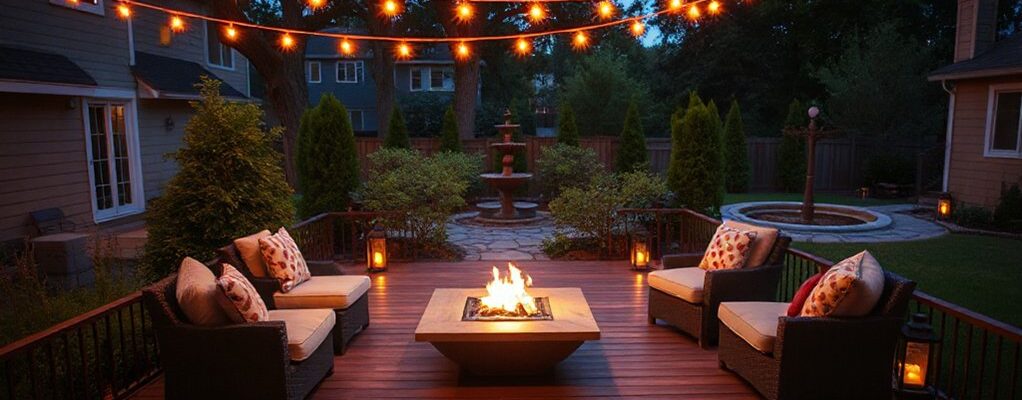
Layer your outdoor lighting to shape evening experiences with precision: layer warm string lights, lanterns, and path lamps to cultivate intimacy and safety, while using targeted accents to reveal architecture and landscape features. Prioritize dimmers, weatherproof fixtures, and smart controls to adjust mood on demand, and plan placements for minimal glare and bugs. With careful testing at dusk and a concise maintenance routine, you’ll achieve a balanced, functional space—but the best arrangement still invites you to explore further.
Key Takeaways
- Create a layered lighting plan with ambient, task, and decorative lighting to set mood and ensure safety during evening entertaining.
- Use dimmers and smart controls to flexibly shift from casual to formal atmospheres as guests arrive or activities change.
- Highlight outdoor features with focal accents (statues, textures) while softly illuminating paths and seating areas for safe navigation.
- Choose warm 2700–3000K lighting for inviting spaces, and cooler 4000–5000K for clarity in work zones and BBQ areas.
- Prioritize weatherproof, glare-controlled fixtures (IP-rated, full-cutoff) and discreet placement to minimize insect attraction and distractions.
Foundation: Why Layer Outdoor Lighting for Evenings
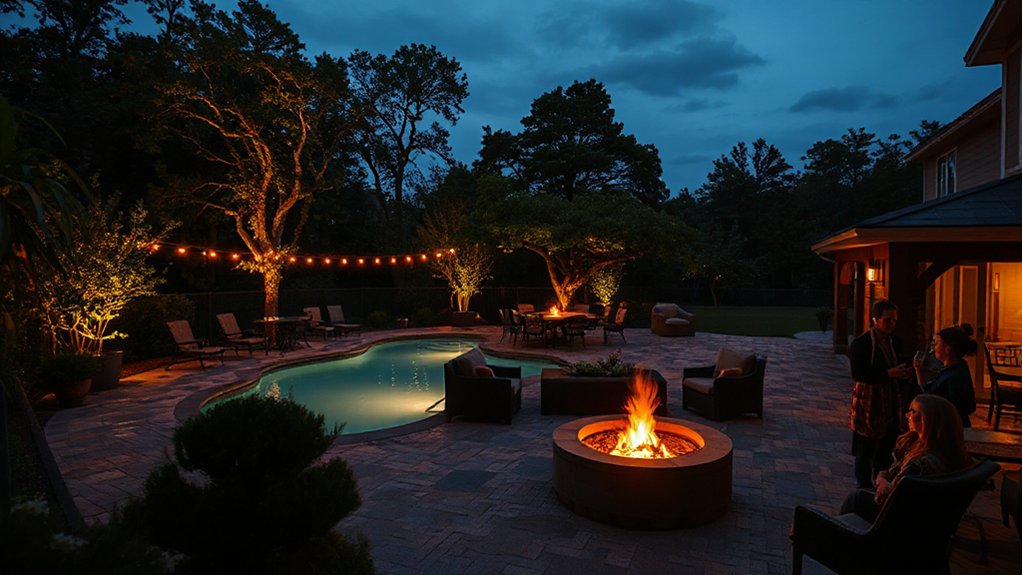
Layering outdoor lighting creates a cohesive, functional nighttime environment by combining ambient, task, and accent layers. You plan with a systems mindset, aligning light levels to a defined sequence and avoiding glare.
Foundation lighting guarantees safe circulation, directs sightlines, and reduces energy waste through zoning and automated controls. Consider plant integration to soften harsh shadows while preserving visual hierarchy; integrate fixtures with landscape features so greenery filters transmission, not signal.
For seating comfort, place luminaires to minimize eye contrast at occupied zones, enabling readable credentials of the space without overpowering it. Use shielded, low-glare fixtures to maintain color accuracy on surfaces and textures.
Document lumen targets, color temperature, and mounting heights, then test during dusk. This foundation supports scalable, adaptable layers for evolving evening activities.
Create Ambiance With String Lights and Lanterns
To establish an inviting nighttime mood while maintaining the foundation’s clarity, introduce string lights and lanterns as a flexible ambient layer that shapes atmosphere without overpowering focal elements. You should deploy string lights overhead in linear sequences to maintain even luminance along primary gathering zones.
Place lanterns at eye level to create pockets of warmth without glare. Consider color temperature around 2700–3000K for intimacy while preserving scene fidelity. Integrate garden sculptures as sculptural punctuation, guiding attention and providing anchors for visual rhythm.
Match lighting intensity to task areas, ensuring patio furniture remains clearly defined for conversation and comfort. Use dimmers and smart controls to modulate scenes between casual and formal settings, preserving hierarchy and minimizing contrast disruption.
This approach yields cohesive ambiance without compromising architectural clarity or focal objects.
Pathways and Safety: Subtle Lighting That Guides Guests
You’ll establish a precise lighting sequence along walkways using subtle, low-profile fixtures that clearly delineate path edges.
Implement safe entry guidance with even illumination levels, glare control, and contrast that helps guests navigate steps and shifts without distraction.
Prioritize integration with terrain and architecture, ensuring reliability, energy efficiency, and ease of maintenance while guiding movement.
Subtle Path Lighting
Choose warm color temperatures (2700–3000K) to preserve garden aesthetics and avoid color distortion of plant textures. Optical dispersion should be narrow, focusing on pathways rather than surrounding foliage, with a consistent spacing plan that avoids dark gaps.
Integrate hardware into landscape elements to enhance landscape integration, using recessed, bollard, or step-lights that align with hardscape planes. Prioritize IP ratings and energy efficiency, testing illuminance levels to sustain safety without visually overpowering the scene.
Safe Entry Guidance
Use warm color temperatures (2700–3000K) to preserve garden aesthetics while maintaining legibility. Integrate step lights at eye level and shielded wall-mounted fixtures to minimize reflections on glass and water features.
Align luminaires with architectural lines to guide guests smoothly from street to door, signaling pauses at porches or seating alcoves. Keep clutter out of sight to avoid trip hazards, and embed timers or adaptive controls for consistent ambience.
This approach enhances outdoor decor while prioritizing safety and effortless navigation.
Flood vs. Accent: Lighting for Focal Points
Flood lighting and accent lighting serve distinct roles in highlighting focal points, so start by selecting a primary function: floodlights provide broad, even illumination to establish context and guarantee safety, while accent lights deliver targeted contrast to reveal texture, form, and drama on specific features.
You’ll balance coverage with emphasis, ensuring garden focal points read clearly at night and decorative illumination enhances architectural cues without glare.
- Identify primary focal points and assign a floodlight plan for general visibility.
- Use accent lighting to sculpt texture on statues, urns, or architectural details.
- Limit light spill with shields and selective mounting heights.
- Dim controls align brightness with mood and safety needs.
- Integrate path and step lighting to guide movement and preserve ambiance.
Warm vs. Cool: Choosing Color Temperature by Atmosphere
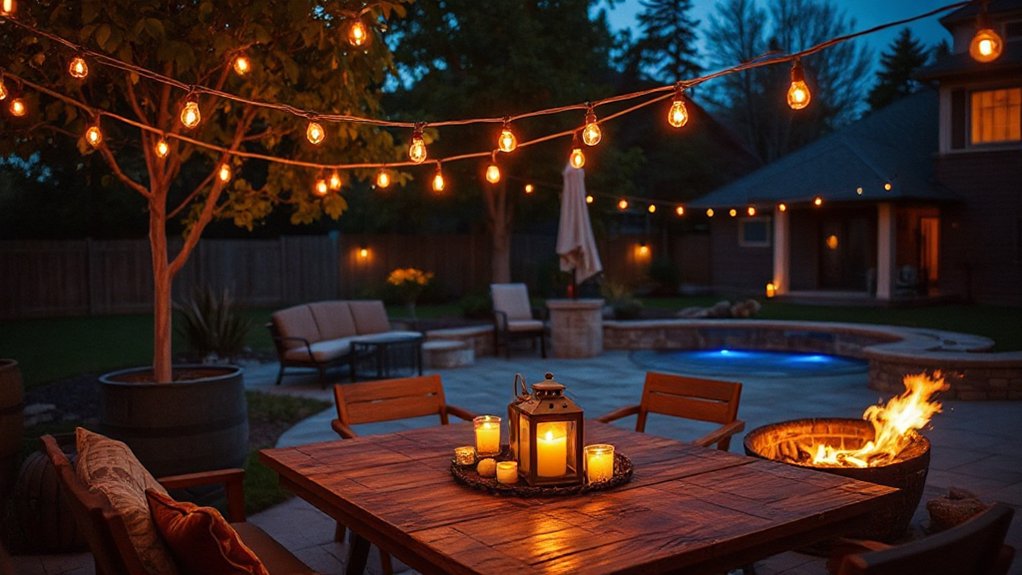
Choosing the right color temperature hinges on atmosphere and function: warm light (roughly 2700–3000K) creates inviting, intimate spaces, while cool light (about 4000–5000K) enhances clarity, texture, and safety in work zones.
You’ll balance ambience and task needs by aligning temperature with activity zones and social goals. Color psychology guides mood: warm hues evoke coziness and conversation, cool hues sharpen perception and delineate edges, improving navigation at night.
In practical terms, pair warm lighting near seating to foster comfort, and deploy cooler, higher-CRI fixtures along pathways, steps, and outdoor kitchens to boost lighting contrast and reduce missteps.
Consider mixed layering—soft ambient, brighter task, and targeted accent—to achieve depth, depth perception, and a refined outdoor experience without glare.
Budget-Friendly Picks Under $50
- Pathway solar lanterns with warm temp and even spread
- Battery-powered LED string lights for flexible spacing
- Compact wall-mount sconces in matte finishes
- Clip-on solar spotlights for targeted accents
- Rechargeable puck lights for step visibility and privacy
Choose pieces that pair with existing landscape textures and plant materials. Prioritize IP ratings, color temperature around 2700–3000K, and dimmable functionality when possible.
This approach preserves design integrity, reinforces safety, and keeps your garden design cohesive while staying within a $50 budget.
Smart Outdoor Lighting That Syncs With Music
Focus on music synchronization that preserves clarity: cool whites for structural highlights, warm accents for social zones, and dynamic accents that echo bass linchpins without overwhelming dialogue. Integrate outdoor soundscape sensors to minimize latency and prevent clashing cues.
Choose weather-rated fixtures with durable drivers and secure mounting, favoring low-profile housings for architectural fidelity. Document scenes for entertaining, then tweak sensitivity and thresholds to maintain consistent visual rhythm throughout your event.
Weather-Resistant Solutions You Can Trust
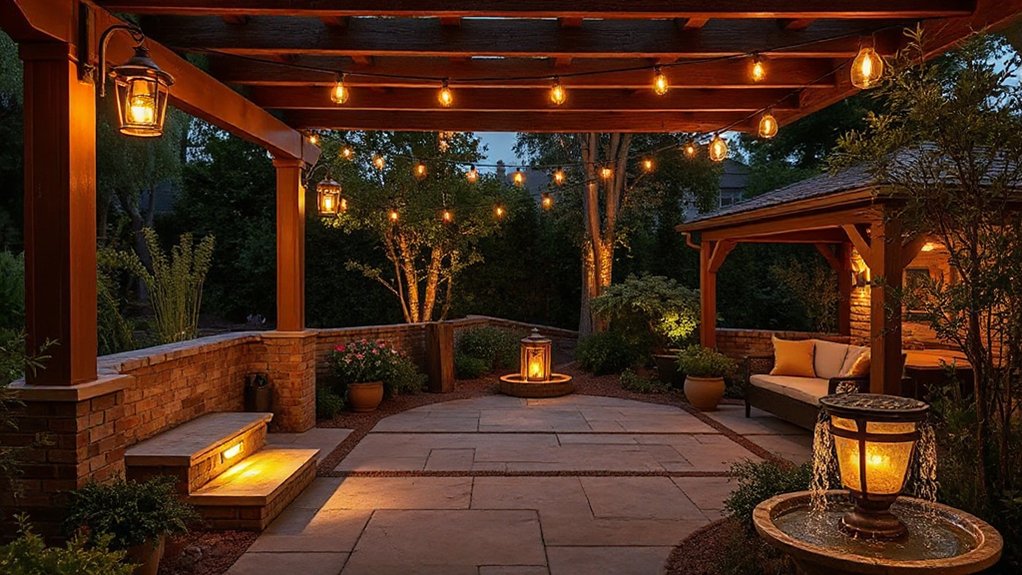
Weatherproof materials matter for lasting outdoor lighting, so you’ll prioritize enclosures, seals, and finishes rated for the expected exposure.
Trustworthy weather-resistant solutions rely on tested IP ratings, UV stability, and corrosion resistance to keep performance steady across seasons.
Start with materials and assemblies that maintain optical clarity and electrical integrity even in moisture-heavy environments.
Weatherproof Materials Matter
When selecting outdoor lighting, choose weatherproof materials designed to endure moisture, temperature swings, and UV exposure without performance degradation. You’ll rely on materials that resist corrosion, cracking, and discoloration, ensuring consistent light output and long service life.
Precision in material selection supports garden design and cohesive outdoor decor, delivering reliability from dusk to late night.
- Corrosion-resistant alloys and powder coatings for durable finishes
- UV-stable plastics and composites to prevent yellowing
- Impact-resistant housings for high-traffic setups
- Waterproof seals rated for IP65 or higher
- Stainless steel or aluminum components with compatible fasteners
This approach creates a restrained, engineering-forward aesthetic, reducing maintenance while maximizing lighting uniformity and color fidelity.
Weatherproof choices reinforce thoughtful design, not just protection.
Trusted Weather-Resistant Solutions
Leveraging trusted weather-resistant solutions starts with proven enclosures, seals, and finishes that maintain performance under moisture, temperature swings, and UV exposure. You select Spectra-rated housings with IP67 ratings, gasketed seams, and UV-stable polymers to guard electronics and optics in mixed climates.
Pair these with corrosion-resistant mounting hardware and controlled-venting that prevents condensation without compromising ingress protection. For aesthetics and durability, apply powder-coated aluminum or high-performance composite shells that resist pitting and fading, while ensuring seamless integration with lanterns, path luminaires, and accent fixtures.
Design-forward installation embraces discreet cable management and modular components, enabling rapid serviceability. Consider garden sculptures and water features as focal elements; position lighting to emphasize textures without overpowering details.
These solutions deliver reliable, long-term performance for exterior landscapes governed by weather.
Placement Tricks: Height, Spacing, and Layering
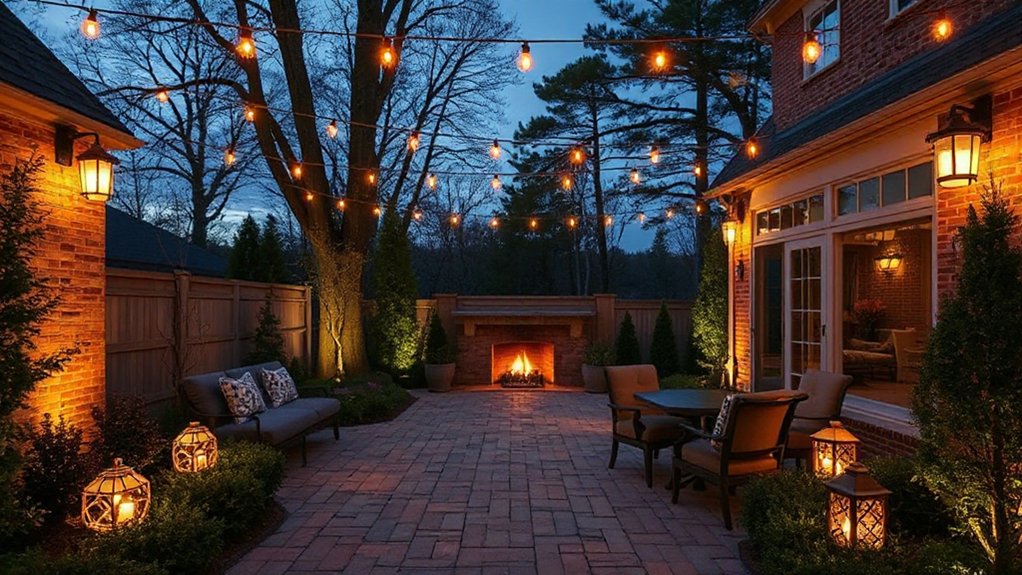
To optimize outdoor illumination, height, spacing, and layering must work in concert: place fixtures so their beams intersect at intended targets while avoiding glare and light spill. You’ll achieve clean hierarchy by selecting fixtures with matched beam angles, then staggering heights to define zones without overlap.
Layered lighting emphasizes focal points, such as garden art, while preserving functional visibility for paths. Careful plant placement guides shadows, reducing clutter and enhancing texture.
Maintain consistent color temperature to preserve mood, and use dimmable options for event control. Precision mounting ensures stable geometry, preventing drift over time.
- Calibrate beam spreads to target layers without encroaching on adjacent zones
- Elevate fixtures to create depth while avoiding glare
- Align accents with garden art focal points and plant placement
- Use dimming to modulate intensity by zone
- Check line-of-sight from seating areas for consistent viewing
Bug-Free Ambiance: Practical Tips to Minimize Glare and Bug Attraction
Glare and bug attraction don’t have to coexist with good outdoor lighting. You can optimize luminance control by selecting fixtures with full cutoff optics and applying low-glare lenses, which reduces stray light into vegetated zones.
Use warm-color LEDs in the 2700–3000K range to minimize insect appeal while preserving color accuracy for garden aesthetics.
Position fixtures below eye level and shield housings to prevent upward spill, directing light along paths and focal plantings.
Implement motion-activated or timed controls to avoid constant illumination, which lowers wildlife attraction and preserves ambiance.
Consider indirect methods, like uplighting shrubs with diffused halo, to maintain depth without hotspots.
Pair lighting with thoughtful plant palettes, supporting garden aesthetics and resident wildlife without compromising comfort.
Continuous calibration guarantees a bug-free, glare-aware environment.
Quick-Install Tips and Final Checklist
You’ll follow precise Quick-Install Steps to outline fixture placement, routing, and testing, with a focus on clean, cable-free aesthetics.
Address Wiring and Safety Tips first, confirming insulation, water resistance, and load compatibility before energizing the system.
Use the Final Checklist Essentials to verify components, connections, and compliance, ensuring a ready-to-use, design-forward outdoor lighting installation.
Quick-Install Steps
- Define zones and toggle scenes for entertaining areas
- Map power sources and confirm cable routing away from moisture
- Position fixtures to illuminate focal elements without glare
- Verify color temperature and brightness for ambiance
- test run, adjust angles, and document final layout
Final check: guarantee all components are rated for outdoor use, verify accessibility for future maintenance, and capture a reference schematic for quick tweaks.
Wiring and Safety Tips
Wiring and safety are non-negotiables in quick-install projects: start with a clean electrical plan that identifies AC and low-voltage paths, then isolate power with a lockout, test circuits, and verify moisture-rated enclosures before any fixture is connected.
You’ll document conduit routing, junction box access, and cable strain relief to minimize future maintenance. Use weatherproof enclosures and color-coded conductors to reduce miswiring risk, and guarantee GFCI protection where required.
For landscape integration, conceal wiring within landscape features using low-profile conduits and fixings that don’t compromise aesthetics.
Prioritize energy efficiency through integrated controls, dimming, and occupancy sensing, aligning with lumen targets and uniform spacing.
Keep a final inspection checklist focused on continuity, insulation resistance, and moisture sealing to assure reliable operation and safe outdoor performance.
Final Checklist Essentials
As you wrap a quick-install project, the Final Checklist tightens quality control and guarantees durable outdoor lighting performance. You’ll validate fixtures, verify wiring, and confirm safe clearance around garden sculptures and water features.
Tighten connections, seal housings, and document cable routing to minimize future maintenance. Inspect glare, color temperature, and beam spread to preserve design intent.
Confirm power budgeting aligns with ambient needs and outdoor durability ratings, then test all switches and dimmers for reliability. Record contractor notes and warranty details to ensure accountability.
This rigor prevents post-install surprises and supports long-term performance in varied conditions.
- Verify fixture integrity, seals, and mounting alignment
- Confirm electrical rating, GFCI protection, and cable routing
- Recheck illumination goals for garden sculptures and water features
- Test switches, dimmers, and timers; log performance
- Archive specs, warranties, and maintenance plan
Frequently Asked Questions
How to Balance Brightness for Intimate vs. Large Gatherings Outdoors?
For intimate gatherings, you balance brightness with ambient glow by layering lighting to create depth: use warm, dimmed fixtures at seating zones and subtle uplights for textures.
For large groups, dial up lighting layers with brighter task and path lights, while maintaining an ambient glow around gathering edges to prevent harsh contrasts.
Adjust dimmers in real time, use zoned controls, and guarantee consistency across fixtures so the lighting remains inviting through every seating arrangement.
What Warranty Considerations Are Essential for Outdoor Lighting?
Warranty policies are essential, and a recent study shows 92% of outdoor lighting failures occur within the first two years. You should review coverage periods, exclusions, and what constitutes “defect” versus wear.
Look for outdoor lighting guarantees that include weather events and UV exposure. Confirm replacements are free or discounted, and note transferability.
You’ll want clear commissioning and service terms, with documented maintenance requirements, to safeguard performance and design integrity.
Which Power Sources Work Best for Temporary Setups?
For temporary setups, you’ll want portable, efficient options like solar-powered fixtures with integrated panels. You’ll rely on solar charging to top up during daylight, reducing generator needs.
Use rechargeable batteries with high cycle life to maximize battery longevity, and choose LEDs for brightness at low power draw.
Guarantee quick setup, weatherproof housings, and cable-free installation.
Prioritize modular components you can rearrange, and verify you can easily swap batteries to maintain uninterrupted lighting.
How to Implement Safe, Cord-Free Lighting Options?
You step into a quiet workshop where a lantern lights your path without cords, like a brave lighthouse tucked in a garden. You deploy solar lanterns and LED stringlights, keeping wires at bay and panels toward the sun.
You verify placement, grounding, and automatic dusk-to-dawn timers, ensuring safe, cord-free operation. You favor shielded connectors and weather-rated fixtures, and you test the system before guests arrive.
Embracing precision, practicality, and enduring, radiant simplicity.
What Are the Best Color Temperatures for Different Outdoor Textures?
For textured outdoor surfaces, use color temperature to define the mood and highlight details. Opt 2700–3000K for warm brick, wood, and stone to enhance coziness.
3500–4100K works well for architectural textures and masonry, delivering clarity without glare.
For vibrant patios, 4200–5000K emphasizes modern materials.
Always pair with dimmers and zoning to control mood lighting; adjust per activity, ensuring consistency across adjacent textures.
Conclusion
Layer your evenings with a precise, design-forward approach that feels effortless. When you test at dusk, you validate color, glare, and scale, turning theory into tangible ambiance. Picture warm string lights tracing decks, lanterns guiding paths, and accent beams highlighting architecture—each layer working in concert. Use dimmers and weatherproof, smartly placed fixtures to tweak mood on command. Maintain clean lines and minimal bug attraction with thoughtful spacing. The result: an instantly memorable, functional outdoor stage for gatherings.